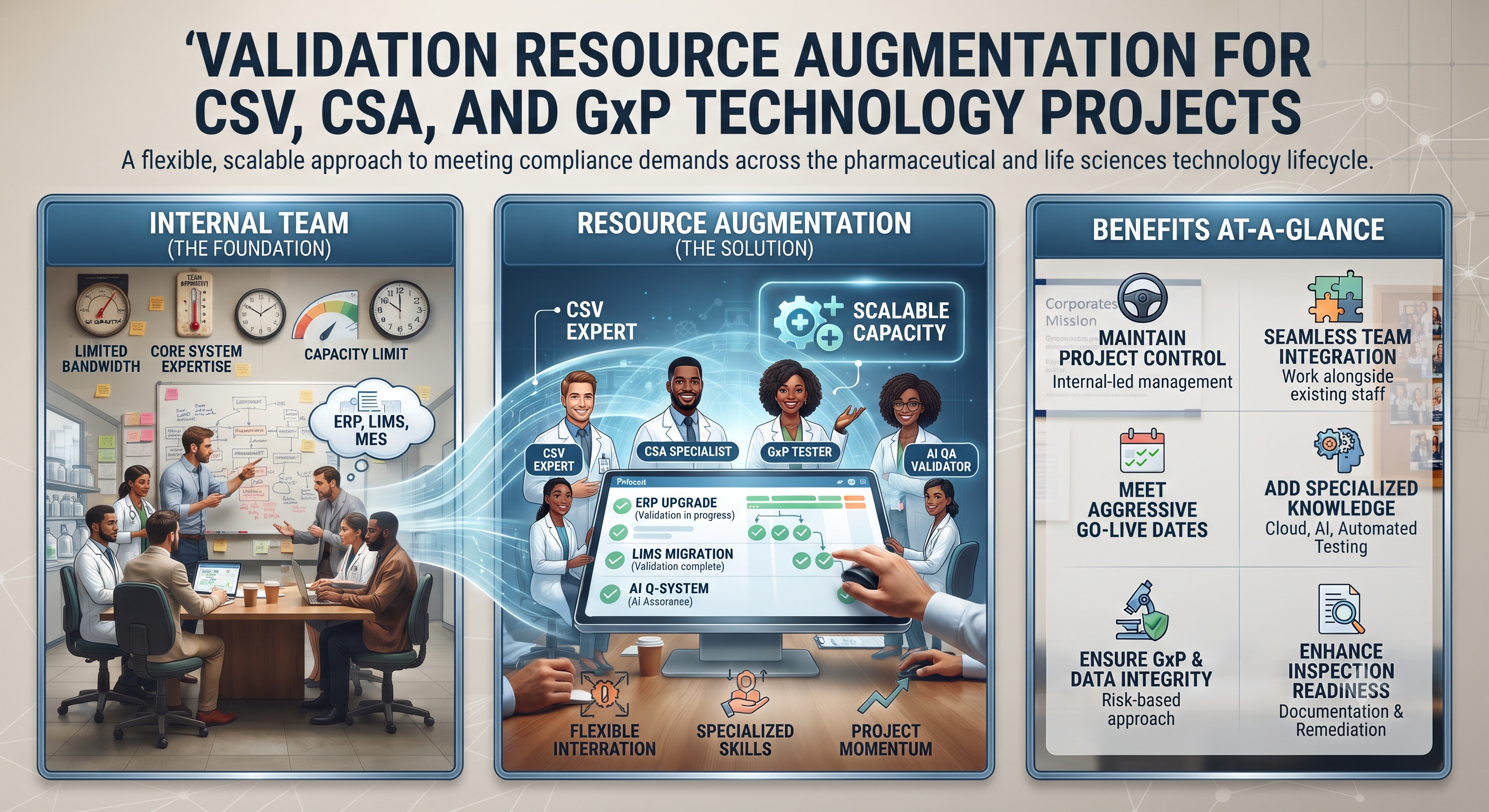
Pharma and life sciences companies are managing technology environments that just keep getting more complex. ERP, LIMS, MES, eQMS, cloud applications, laboratory platforms, automated systems, AI-enabled tech, all of it creates validation and compliance work that internal teams don’t always have the capacity or the specialized expertise to actually cover.
Validation resource augmentation helps close that gap by adding qualified validation professionals onto existing quality, IT, validation, and project teams for specific technologies, specific projects, or whenever demand spikes.
Instead of permanently growing headcount or handing off the entire validation function to someone else, companies can bring in GxP validation resources based on what the project actually needs. These professionals can support CSV, CSA, risk assessment, software testing, documentation, remediation, system implementation, and inspection readiness, all while the organization keeps control of its own processes.
For companies facing aggressive go-live dates, overlapping implementations, validation backlogs, or specialized technology needs, resource augmentation offers a genuinely flexible way to build validation capacity without stalling project momentum.
Even well-established pharma organizations can run into validation capacity shortages. Digital transformation’s driven up both the number and the complexity of computerized systems supporting regulated operations, while internal validation teams still have to manage existing systems and routine compliance work at the same time.
An organization might be rolling out an eQMS while upgrading ERP, migrating LIMS, and bringing in new manufacturing technology, all at once. Each project needs requirements review, risk assessment, testing, documentation, and Quality oversight.
Extra validation project resources can keep overlapping initiatives from burying the same internal specialists.
Traditional CSV experience doesn’t automatically cover every modern environment. Cloud platforms, SaaS applications, automated testing, AI-enabled applications, newer assurance methodologies, all of it can call for additional capability.
Resource augmentation lets organizations add specialists for these needs without permanently hiring for every single technology that shows up.
New implementations don’t erase periodic reviews, change controls, incidents, upgrades, access reviews, and existing system responsibilities. That work keeps going regardless.
Internal teams can get overloaded fast when project work gets stacked on top of ongoing lifecycle activities.
Audit findings, remediation commitments, system releases, regulatory priorities, all of it can create fixed timelines. Extra resources give you execution capacity for when delaying the work just isn’t a realistic option.
The real value of resource augmentation is its flexibility. Organizations can add professionals based on the project stage, system type, internal capability, and the specific validation gap they’re actually dealing with, rather than buying a fixed package that might not reflect what they actually need.
Experienced resources can support validation plans, system assessments, project scope, lifecycle strategies, responsibilities, and assurance approaches, all shaped around intended use and GxP impact.
Validation professionals work with process owners and technical teams to build or review requirements and identify functionality that could affect patient safety, product quality, data integrity, or regulated decisions.
Resources can support test planning, test case development, execution, evidence review, defect management, and traceability.
Risk-based testing expertise is especially useful when organizations want to put assurance effort where it actually matters, rather than testing every single feature with identical rigor whether it’s critical or not.
Extra professionals can support requirements, risk assessments, protocols, test evidence, traceability matrices, deviations, validation reports, and other lifecycle documentation, following whatever the organization’s procedures actually require.
Resources can review validation packages, spot gaps, organize evidence, support remediation work, and help internal teams strengthen computerized system readiness before audits or regulatory inspections show up.
Computer System Validation stays fundamental across pharma technology environments. But major implementations and upgrades can create more work than a permanent validation team can absorb on its own.
CSV resource augmentation lets organizations add professionals who actually know computerized system lifecycle activities, without handing off complete ownership of the project to someone external.
ERP implementations and upgrades can touch materials, inventory, master data, manufacturing, quality, and other regulated processes. CSV professionals can support risk assessment, testing, interfaces, migration activities, and validation documentation.
Laboratory systems can influence sample management, specifications, calculations, results, approvals, and critical quality data. Relevant CSV expertise helps organizations work through these functions systematically rather than piecemeal.
Manufacturing Execution Systems might support electronic batch records, production workflows, equipment interactions, process parameters, and approvals, which adds up to substantial validation requirements.
Electronic quality and document systems can support deviations, CAPA, change control, training, document approval, and other regulated workflows that need real assurance behind them.
Cloud systems need a clear understanding of supplier responsibilities, configuration, data management, integrations, upgrades, security, and change controls. Experienced resources help internal teams actually navigate all of that.
Computer Software Assurance has pushed regulated organizations to lean more on critical thinking, intended use, risk, and meaningful testing.
That said, moving from established CSV processes toward CSA isn’t just about trimming documentation.
Experienced CSA consultants can help organizations figure out where risk-based assurance actually makes sense, while still keeping appropriate evidence and Quality oversight intact.
CSA specialists can help teams identify critical functions and decide on assurance activities based on potential impact, not just organizational habits.
Not every function needs the same heavily scripted approach. Experienced professionals can help pick testing methods that are actually proportionate to risk and suited to the particular system involved.
Organizations can use CSA principles to figure out whether legacy procedures have unnecessary steps that eat time without actually improving assurance.
A successful CSA transformation needs more than revised templates. Validation, Quality, IT, business teams, and testers all need to understand how risk-based decisions actually work in practice, not just on paper.
The skills validation work needs are shifting alongside the technology itself. Modern validation staffing should stretch beyond traditional computerized system documentation.
Automation can improve repeatability and efficiency for suitable assurance activities, but teams still need professionals who understand both software testing and regulated evidence requirements together.
AI brings extra considerations, intended use, data quality, model performance, risk assessment, human oversight, change management, lifecycle monitoring.
Organizations introducing AI might need specialized resources who can actually connect established GxP validation principles with emerging AI assurance requirements.
Large digital initiatives often involve multiple applications, suppliers, interfaces, migrations, and business processes all at once. Flexible life sciences staff augmentation lets organizations scale validation capacity up as different project phases develop.
Resource augmentation and outsourcing can both be genuinely useful, but they solve different organizational problems.
| Factor | Resource Augmentation | Complete Outsourcing |
| Project Control | Internal | More vendor-led |
| Team Integration | High | Varies |
| Best For | Skill/capacity gaps | Defined work packages |
| Scaling | Flexible | Contract dependent |
| Management | Client-led | Provider-led |
| Knowledge Transfer | Direct | Depends on model |
Organizations with established processes and leadership often prefer augmentation when they just need extra execution capacity or specialized expertise, not a whole new process.
A defined validation package with clear deliverables might fit outsourcing better instead.
Just adding people doesn’t automatically fix a project problem. Resources need to actually match the technology, the regulated process, the project phase, and the specific gap you’re trying to close.
ERP, LIMS, MES, eQMS, cloud, and AI projects can all need different validation knowledge. Relevant system experience shortens the learning curve and improves how much someone can actually contribute.
Generic software or IT experience just isn’t enough for a lot of regulated projects. Professionals need to actually understand GxP environments, validation principles, data integrity, risk, testing, and proper documentation.
Organizations increasingly benefit from resources who can work with established CSV processes while also understanding modern risk-based CSA approaches.
Validation professionals collaborate with Quality, IT, Engineering, Manufacturing, laboratories, vendors, and business process owners constantly. Real communication matters a lot when external resources join an existing team.
Companies should nail down the required skills, system, responsibilities, expected duration, deliverables, and reporting structure before selecting resources. Better-defined requirements lead to better matches, plain and simple.
A validation staffing partner needs to understand a lot more than just recruitment. It needs to understand what pharma validation projects actually require day to day.
Pharma Connections provides validation resource augmentation for pharma and life sciences organizations needing extra expertise across CSV, CSA, GxP technology, software testing, compliance, and modern validation programs.
Organizations can access professionals aligned with traditional Computer System Validation as well as modern Computer Software Assurance and risk-based approaches.
Pharma Connections supports requirements around risk-based testing, test execution, evidence, defect management, traceability, and regulated software assurance.
Resources can support validation reviews, gap identification, remediation, documentation readiness, and preparing GxP applications for audits and regulatory inspections.
As pharma organizations bring in AI-enabled applications, Pharma Connections supports emerging requirements around AI risk assessment, testing, GxP assurance, lifecycle controls, and validation.
Whether an organization needs computer system validation staffing for a major implementation, temporary resources to clear a backlog, or specialized expertise for a technology project, support can get aligned with what the project actually needs.
Pharma Connections also works the other side of the equation, developing professionals who can actually meet industry expectations.
Through practical training in CSV, CSA, GxP software testing, risk-based validation, documentation, compliance, and emerging AI validation, Pharma Connections gets professionals ready for validation opportunities with pharma companies, MNCs, CROs, consulting organizations, and other life sciences employers.
The focus stays on connecting theoretical knowledge with actual project responsibilities. Professionals need to understand not just what validation terminology means, but how requirements, risks, testing, deviations, traceability, and lifecycle activities all fit together in real regulated environments.
That connection between professional training and real enterprise validation needs is what keeps Pharma Connections aligned with both organizations looking for qualified resources and candidates getting ready for careers in the field.
GxP technology projects shouldn’t lose momentum just because internal validation teams don’t have the capacity or specialized expertise. Validation resource augmentation gives pharma and life sciences organizations a genuinely flexible way to strengthen existing teams while keeping control of critical projects and compliance processes.
Pharma Connections provides CSV resource augmentation, CSA consultants, GxP validation resources, software testing expertise, audit and inspection support, and emerging AI validation capabilities, all aligned with different technology and project needs.
Whether you’re implementing a new GxP application, managing multiple validation projects, working through a compliance backlog, transitioning toward CSA, or bringing in AI-enabled technology, Pharma Connections can help extend your team with real validation expertise.
Need additional validation resources for an upcoming GxP technology project? Connect with Pharma Connections to build the right validation team around what you actually need.
1. What is validation resource augmentation?
It lets pharma and life sciences organizations add external validation professionals onto existing teams for specific projects, temporary workload spikes, or specialized technology and compliance needs.
2. What types of validation resources can companies augment?
Companies might need CSV professionals, CSA consultants, GxP software testers, validation documentation specialists, compliance professionals, system-specific experts, or resources supporting audit and inspection readiness.
3. When should companies consider CSV resource augmentation?
It can help during ERP, LIMS, MES, eQMS, cloud, and other GxP implementations, upgrades, migrations, validation backlogs, remediation programs, or temporary internal resource shortages.
4. How is validation staff augmentation different from outsourcing?
Staff augmentation folds external professionals into the organization’s existing team and management structure. Outsourcing generally hands an external provider more responsibility for delivering a defined project scope or work package.
5. Does Pharma Connections provide validation staffing solutions?
Yes. Pharma Connections supports pharma and life sciences organizations with CSV and CSA resources, GxP software testing, validation staffing, audit and inspection readiness, and emerging AI validation expertise.
Artificial intelligence is quickly moving beyond testing into core pharmaceutical processes. AI-based applications can support…
Pharmaceutical validation teams don’t always need the same resources year-round. A business might be adequately…
Pharmaceutical manufacturing and regulated technology environments are increasingly shifting toward artificial intelligence, but implementing an…

Pharma Connections, Established on February 14, 2019, A Product of Eduteq Connections Pvt Ltd (An ISO 9001:2015 certified company), is dedicated to providing training and upskilling opportunities for Life science Professionals.
Read More