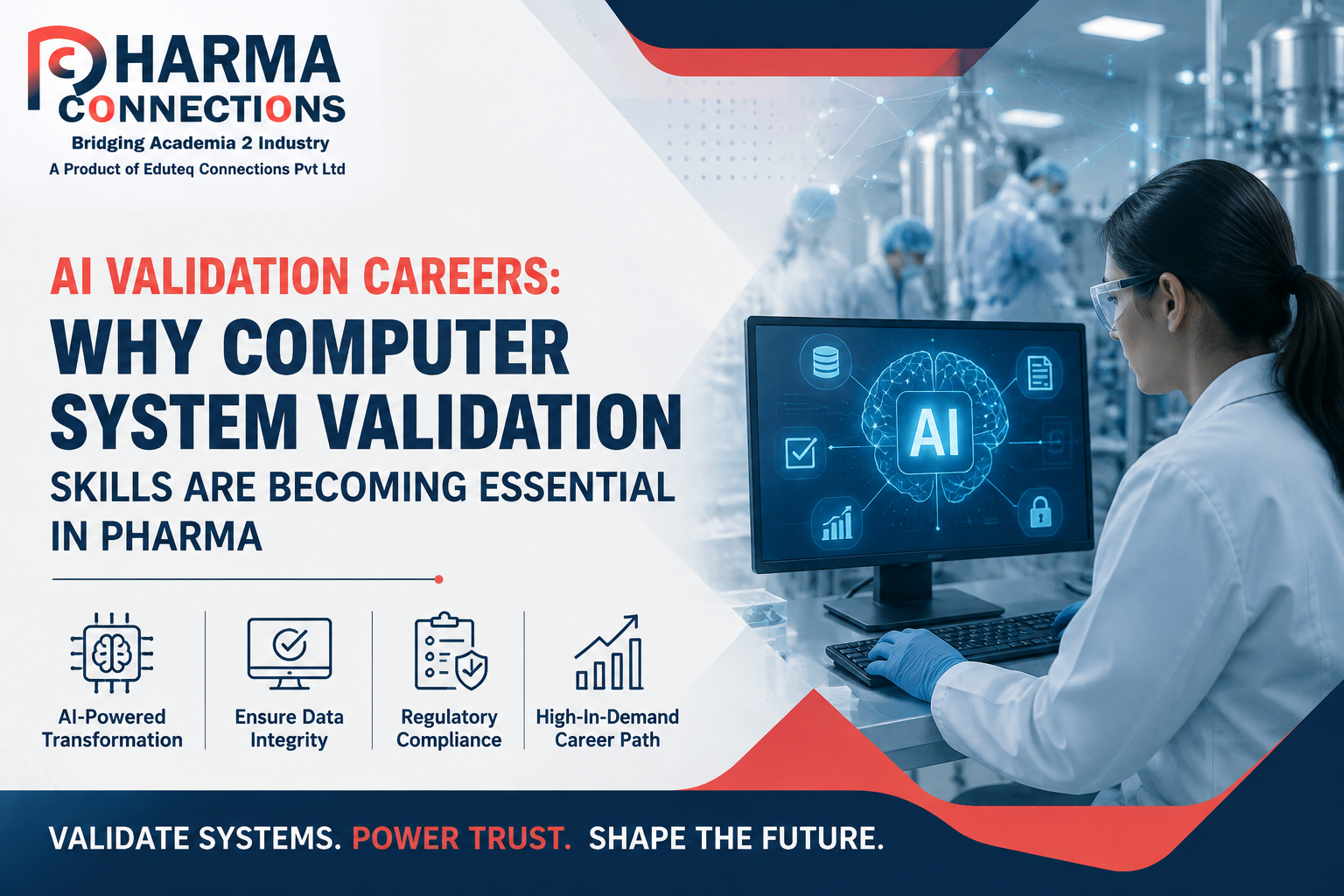
The field of AI validation is quickly becoming a professional discipline, with pharmaceutical organizations using artificial intelligence and machine learning in quality management, production, laboratory activities, regulatory practices, pharmacovigilance, and data-informed decision-making. As AI has great potential to enhance efficiency, accuracy, and compliance, it brings along new regulatory and validation issues. Any AI-based system being used in a controlled pharmaceutical setting should be evaluated on reliability, data integrity, purpose, and adherence to regulatory expectations.
This increasing requirement has generated great demand among the experts in Computer System Validation (CSV) and Computer Software Assurance (CSA). With the increased application of intelligent technologies in pharmaceutical organizations, validation professionals who understand AI are becoming not only a necessity to enable compliant innovation but also present exciting new career opportunities throughout the life sciences sector.
Why Artificial Intelligence Is Creating New Validation Careers
Artificial intelligence is changing almost all the functions in the pharmaceutical industry. AI is becoming a component of contemporary pharmaceutical processes, from automating repetitive processes to aiding in making quality choices and speeding research. As more of these systems are adopted, companies require professional services that can certify them and promote regulatory compliance and patient safety.
AI Is Expanding Across Pharmaceutical Operations
AI is currently employed in manufacturing, quality control, laboratory work, clinical studies, pharmacovigilance, supply chain, and regulatory systems. Every implementation develops new validation duties.
Intelligent Systems Require Regulatory Oversight
AI systems do not necessarily treat data as inputs, and unlike traditional software, they can be trained to help in making intricate decisions. Validation professionals can be used to aid in making sure that these systems can be used over their lifecycle and always operate according to plan.
Compliance Requirements Continue to Evolve
Regulators release new guidelines, industry expectations are emerging, and AI-enabled technology applications require professionals who know how to ensure the operation of validation principles.
Companies Need Specialists Who Understand Both AI and Validation
With escalating demand to align emerging technology with regulated compliance domains, pharmaceutical organizations are more likely to pursue professionals who can help close this divide, and validation expertise is becoming more treasured than ever.
AI Is Accelerating Demand for Specialized Talent
The rapid adoption of AI has outpaced the supply of qualified validation experts, creating a strong career opportunity for those who can specialize in Computer System Validation and Computer Software Assurance.
Why Computer System Validation Remains Essential for AI Systems
Even though AI brings new functionality, the core purpose of validation stays the same: computerized systems should be fit for purpose, work effectively, guarantee data integrity, and adhere to regulatory standards. With the growing adoption of AI in pharmaceutical workflows, Computer System Validation is the basis for implementing these technologies safely and within legal regulations.
AI Systems Must Demonstrate Intended Performance
Organizations need to ensure that the AI-enabled application is constantly running as per specified business and compliance needs before the application is deployed in a regulated setting.
Data Integrity Becomes Even More Critical
The quality of data is extremely important in training, processing, and decision-making by AI systems. Validation professionals help ensure data accuracy, completeness, consistency, and reliability throughout the system life cycle.
Risk Assessment Supports Responsible AI Adoption
Not all AI applications will involve the same level of risk. Prior to deciding on suitable validation activities, validation professionals evaluate the potential effect of AI systems on product quality, patient safety, regulatory compliance, and business operations.
Lifecycle Management Continues Beyond Implementation
Validation does not consist of a single activity. To maintain maintenance of AI systems in terms of privacy, the business will have to continually monitor and periodically review, manage changes, and also assess the performance of the systems to make sure that they are still in compliance as the technology and business needs change.
Validation Builds Confidence in AI-Driven Decisions
Regulators, stakeholders, and organizations should consider the production of reliable and traceable outputs by AI systems. Effective validation offers data that can be used to foster trust in AI-guided activities and judgments.
Skills Required to Build Successful AI Validation Careers
The more pharmaceutical companies invest in artificial intelligence, the more employers seek specialists offering expertise in validation, along with knowledge of the current digital technologies. These competencies help guide professionals toward the future of the pharmaceutical profession.
Computer System Validation Expertise
Good awareness of the validation lifecycle, such as requirement definition, risk assessment, testing, documentation, change control, and periodic review is still critical in validating AI-enabled systems.
Computer Software Assurance Methodologies
Computer Software Assurance as a knowledge allows one to use the risk-based strategy of validation that is relevant to the contemporary regulatory thought and facilitates the efficient use of AI.
AI Governance and Compliance Awareness
Professionals will be aware of the principles of responsible AI, regulator expectations, transparency, accountability, and governance frameworks implemented in the controlled pharmaceutical setting.
Data Integrity and Risk Management
Knowledge of ALCOA+, electronic records, and audit trails, as well as risk assessment, will maximize the reliability of AI systems throughout the lifecycle and support compliance.
Cross-Functional Collaboration
Quality Assurance, IT, Data Science, Manufacturing, Engineering, Regulatory Affairs, and Compliance teams are involved in AI validation projects. Individuals with the capacity to cooperate in these functional areas are sometimes very useful to pharmaceutical entities.
Career Opportunities in AI Validation Careers
As artificial intelligence becomes an integral part of pharmaceutical operations, new roles are emerging that combine validation expertise, compliance knowledge, and digital technology skills. Professionals with a strong foundation in CSV and CSA are well-positioned to pursue these opportunities and build long-term careers in one of the industry’s fastest-growing areas.
AI Validation Specialist
AI Validation Specialists assess, validate, and monitor AI-enabled systems used in regulated pharmaceutical environments to ensure they operate reliably while meeting compliance and quality requirements.
Computer System Validation Professional
CSV professionals continue to play a vital role by validating AI-supported computerized systems used across manufacturing, laboratories, quality management, and regulatory operations.
Computer Software Assurance Professional
CSA professionals apply risk-based validation methodologies that help organizations implement AI technologies efficiently without compromising patient safety, product quality, or regulatory compliance.
Digital Compliance Specialist
These professionals oversee compliance activities for AI-powered platforms, cloud applications, and computerized systems while ensuring alignment with regulatory expectations and internal quality standards.
AI Governance and Compliance Professional
As AI governance becomes increasingly important, organizations need professionals who understand validation principles, risk management, data integrity, and responsible AI practices to support compliant AI adoption.
Why AI Validation Careers Offer Long-Term Growth
With AI governance playing a more crucial role, companies require specialists knowledgeable in the principles of validation, risk management, data integrity, and responsible AI practices to facilitate the adoption of AI that complies with specific regulations.
AI Adoption Continues to Accelerate
Pharmaceutical companies are rapidly investing in AI-powered applications to improve operational efficiency, quality management, drug development, manufacturing, and regulatory processes, creating continuous demand for validation expertise.
Regulatory Focus on AI Is Increasing
Regulatory agencies are placing greater emphasis on governance, transparency, risk management, and validation of AI-enabled systems. Organizations need professionals who understand these evolving expectations.
Digital Transformation Depends on Validation
Successful AI implementation requires more than advanced technology. Organizations depend on validation professionals to ensure new systems remain compliant, reliable, and audit-ready throughout their lifecycle.
Specialized Skills Create Competitive Advantage
Professionals who combine CSV, CSA, AI governance, and compliance knowledge possess a unique skill set that is increasingly difficult for employers to find, making them highly valuable in the job market.
Future Career Opportunities Will Continue to Expand
As intelligent technologies become standard across pharmaceutical operations, professionals with AI validation expertise will have access to new roles, leadership opportunities, and specialized career paths within the life sciences industry.
Why Pharma Connections Is Best for Building AI Validation Careers
Pharma Connections would be their place to develop successful AI validation careers with hands-on Computer System validation and Computer Software assurance training. Through the programs, learners will learn to appreciate current validation methodology, AI governance, and risk-based compliance methods that can guide the future of the pharmaceutical industry.
Industry-Focused AI Validation Training
The curriculum uses classical Computer System Validation and brings it up to current CSA approaches, enabling participants to validate AI-enabled systems in regulated pharmaceutical settings.
Practical Learning for Modern Pharma Technologies
The participants will have hands-on experience in validation workflows, computerized systems, documentation, practices with data integrity, and compliance procedures which will aid AI implementation projects.
Modern Risk-Based Validation Approach
The training framework focuses on Computer Software Assurance and risk -based validation concepts and allows professionals to have confidence in supporting AI software in line with the regulations.
Guidance From Experienced Industry Experts
Students gain hands-on experience and exposure to pharmaceutical industry insights from well-established practitioners in validation, compliance, computerized systems, and digital transformation.
Career-Oriented Professional Development
Pharma Connections assists practitioners in building on their new technical proficiency, enhancing marketability, preparing to work in an AI-intensive environment, and achieving long-term employment in the ever-evolving pharmaceutical environment.
Conclusion
The pharmaceutical industry is being transformed by the use of artificial intelligence, though it does not rely solely on the highly developed technology to be applied successfully. All AI-based systems in place in a controlled setting should be tested to ensure compliance, reliability, data integrity, and patient safety.
This increasing demand is turning AI validation professions into one of the most rapidly expanding professions among professionals holding a background in Computer System validation and Computer Software testing.
Individuals who acquire validation expertise nowadays will be well-armed to contribute to quality systems based on AI usage, automated manufacturing, smart laboratory platforms, and additional future digital transformation ventures. With the ever-increasing investment in artificial intelligence by organizations, there will be a growing need for professionals with knowledge of the technology and regulatory provisions.
Pharma Connections is the most suitable source of CSV and CSA training that targets industry-specific preparation for professionals aiming at AI validation careers. With the skills provided through practical learning, modern validation techniques, seasoned industry trainers, and its career-oriented programs, Pharma Connections equips graduates to create successful careers at the borderline of artificial intelligence, validation, and pharmaceutical compliance.
FAQs
1. What are AI validation careers?
AI validation careers involve validating artificial intelligence systems used in regulated pharmaceutical environments to ensure compliance, reliability, data integrity, and patient safety.
2. Why are Computer System Validation skills important for AI?
Computer System Validation ensures AI-enabled systems perform as intended, remain compliant, and continue operating reliably throughout their lifecycle.
3. Can freshers build careers in AI validation?
Yes. Freshers with pharmacy or life science backgrounds can develop CSV and CSA expertise to prepare for emerging AI validation roles.
4. What skills are required for AI validation careers?
Key skills include Computer System Validation, Computer Software Assurance, AI governance, data integrity, risk assessment, validation documentation, and regulatory compliance.
5. How can Pharma Connections help prepare professionals for AI validation careers?
Pharma Connections provides practical CSV and CSA training that helps professionals build the validation, compliance, and risk management skills required for AI-enabled pharmaceutical systems.
Related Posts

How to Find Qualified CSV and CSA Professionals for GxP Projects
When pharmaceutical and life sciences companies manage regulated technology projects, they must recruit the right…
AI Validation in Pharma: How to Validate AI-Enabled GxP Systems Without Slowing Innovation
Artificial intelligence is quickly moving beyond testing into core pharmaceutical processes. AI-based applications can support…
Contract CSV resources: When Should Pharma Companies Use Contract Validation Professionals?
Pharmaceutical validation teams don’t always need the same resources year-round. A business might be adequately…