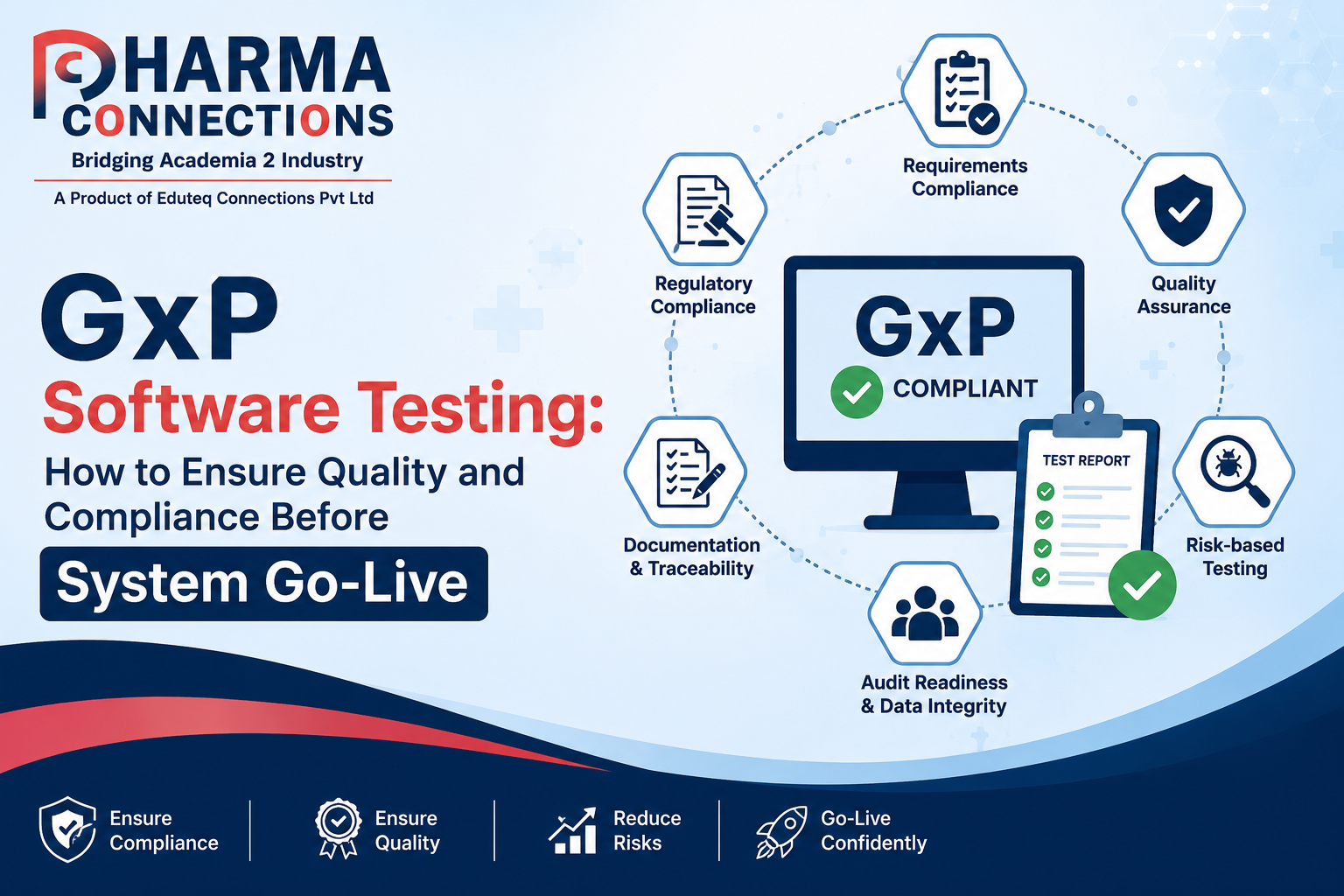
A GxP application may appear technically ready to release, yet cause severe problems once it enters a regulated production environment. A successful installation does not prove that critical workflows function correctly, electronic records are reliable, ease of use works well, or the system is flexible enough to support the desired GxP use.
This is why GxP software testing is a critical stage of system implementation.
Applications that pharmaceuticals and life sciences rely on include Laboratory Information Management Systems (LIMS), Manufacturing Execution Systems (MES), electronic Quality Management Systems (eQMS), Enterprise Resource Planning (ERP), clinical platforms, document management systems, laboratory applications, and cloud solutions.
Testing must provide meaningful evidence that critical functionality meets expectations before go-live, especially when the systems under test support ordered processes.
It should not aim to produce hundreds of test scripts as a demonstration of motion. The key problem in testing GxP applications is what to test, how hard to challenge it, and what evidence to keep.
Go-live is the stage when a computerized system starts to support real business operations and possibly regulated data. Finding a critical problem after the fact can be more disruptive than catching it in a controlled test.
Malfunctions within GxP applications may impact the manufacturing or laboratory test, quality decision-making, clinical operations, or other controlled activities. Testing helps detect significant failures that may affect GxP operations before they occur.
Systems may create, change, process, examine, approve, transfer, and store regulated electronic records. Relevant controls should be checked through testing to ensure data is complete, consistent, accurate, attributable, and has the correct level of protection throughout its lifecycle.
A system should not be released merely because individual technical functions operate correctly. Focus on GxP system testing so key business workflows can sustain the desired regulated process and remain credible under realistic operating conditions.
Post-deployment defects may cause emergency modifications, workarounds, more investigation, business impact, and remediation. Effective pre-release testing minimizes avoidable surprises.
Testing evidence is part of a larger assurance package that illustrates why an organization found a computerized system appropriate to the use for which it was intended under GxP.
No test package fits the one-size-fits-all treatment of all the regulated systems. Testing must be representative of the application’s intended use, complexity, configuration, business process, and associated risks.
Critical requirements are those that should be tested to ensure proper business functions are being done by the system. Test coverage should be logically aligned with approved requirements and identified risks.
Role-based permissions should be questioned to ensure authorized users can carry out relevant processes and unauthorized users cannot access restricted functionality and data.
For electronic records or electronic signatures, the corresponding functionality must be assessed against applicable requirements, such as controls for record reliability and user accountability.
In systems that require audit trails, testing must ensure that appropriate information is captured about activities that have occurred and that the information in the audit trails supports the required regulated process.
GxP applications are infrequently used on their own. Data can be transferred between ERP, MES, and LIMS or eQMS, instruments, databases, or external platforms. Test to verify that critically important information is transferred correctly and completely between pertinent interfaces.
The reports, calculations, transformations, and automated decisions affecting GxP activities should be verification-approved. Both meaningful failure and expected operation conditions should be challenged during testing.
Among such pitfalls in pharmaceutical software testing, the idea that all features are equally significant is one of the largest.
A preference on how a cosmetic is presented is not as risky as a calculation that lead to product release. Compliance can be improved by not necessarily touching both sides of the fence.
Risk-based software testing focuses more attention on areas that do not impact software functionality.
| Risk Level | Example | Testing Approach |
| Higher | Critical GxP calculation | Rigorous challenge |
| Higher | Product quality decision | Strong documented evidence |
| Medium | Controlled workflow | Risk-appropriate testing |
| Lower | Non-critical preference | Proportionate assurance |
The first step that teams should undertake is to know what the system is, what regulated processes are being supported, the people using it, and what outputs can be used to impact on GxP decisions.
Identify those functions that can impact patient safety, product quality, data integrity, or regulatory records. Pay more attention to these areas.
Critical functionality requires testing of successful workflows only. Teams should consider invalid inputs, incorrect permissions, workflow disruptions, integration problems, and other reasonably foreseeable conditions.
Not all requirements require such a highly scripted test method. Decide the method and evidence based on risk, complexity, and the nature of the function under assessment.
Effective software validation testing would not be a surprise a few days before the production deployment. The decisions to be tested in the project should evolve as the project requirements, risks, configurations, and system knowledge become clearer.
Well-defined requirements define what the system has to do. Risk assessment is then used to determine which functions need more controls and testing.
Knowledge of supplier capabilities, standard functionality, configuration, customizations, and system architecture helps teams decide where reassurance is warranted.
Before execution is started, a test strategy must outline the scope and responsibilities, environments, methods, acceptance testing, defects and evidence required.
Tests must be properly documented, including test scenarios and representative data, a controlled environment, and qualified personnel. Results must reflect what actually occurred, not what testers thought would occur.
Failed tests cannot be retaken until they pass. Major breaches must be duly documented, investigated, rectified, evaluated, and re-tested.
Teams should ensure that critical requirements and identified risks are adequately covered with assurance evidence before release, and that any remaining unresolved issues are properly evaluated.
A large testing package can still provide weak assurance when the underlying strategy is poor. Several mistakes repeatedly reduce the effectiveness of validated systems testing.
Taking implementation to its conclusion leaves little time to fix critical bugs and can make validation an obstacle to go-live.
Supplier testing can be strong evidence, but organizations must decide whether it is sufficient to meet their configuration, intended use, GxP risks, and business processes.
Unnecessary checks of non-crucial functionality waste time that could be spent testing processes that are truly important.
Only expected behavior can be tested, without identifying important failure modes. The most important functions are to be challenged.
When teams cannot relate critical requirements and risks to assurance evidence, proving that the system is fit for regulated use becomes a needless challenge.
A well-written test script is worth little if it cannot prove that a vital function is working properly. Assurance should not become a paperwork exercise; it should be supported by evidence.
Before approving a regulated system for production use, organizations should confirm that testing and related validation activities provide adequate evidence of readiness.
Key questions include:
A go-live date should not determine whether a system is compliant. Readiness evidence should determine whether the system is suitable for release.
Regulated technology often presents two issues simultaneously for organizations implementing it: a lack of internal validation capacity and the need for specialized testing skills.
Pharma Connections offers a testing and validation service of GxP software testing and verification of life sciences organizations and pharmaceutical ones with regulated computerized systems.
Examples of support tests are GxP application testing, GxP system testing, software validation testing, risk-based testing, CSV, computer software assurance, validation documentation, audit and inspection readiness, depending on project requirements.
Pharma Connections can help organizations target testing on high-priority requirements and GxP risks instead of applying full-throttle testing uniformly across all system functions.
Contemporary projects might demand both established computer system validation methods and computer software assurance. Pharma Connections helps companies adopt a practical, risk-based approach to assuring computerized systems.
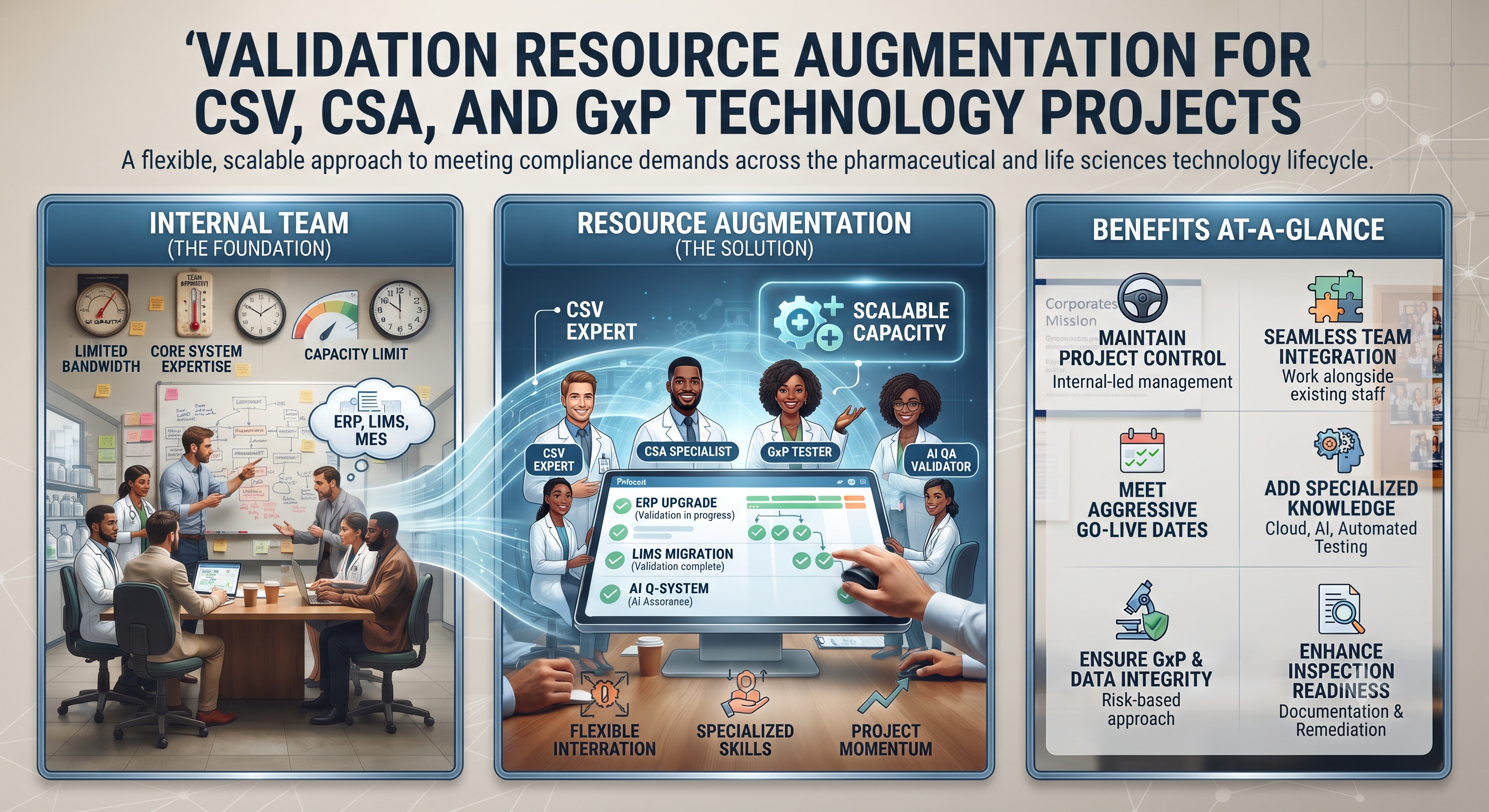
When internal teams lack capacity, Pharma Connections can provide validation resources to test, upgrade, and support implementation, testing programs, remediation, and other GxP technology projects.
Testing evidence must be intelligible, traceable, and justifiable. Pharma Connections helps organizations prepare for GxP application and validation documentation audits and inspections.
Pharma Connections also provides training in CSV, CSA, GxP software testing, validation documentation, regulatory compliance, and emerging technologies, like AI validation. The training helps candidates gain practical skills and become familiar with validation opportunities across companies, MNCs, consulting organizations, and the wider life sciences sector.
GxP compliance testing cannot often be the duty of an individual. Strong projects involve business process owners, quality, validation, IT, the technical team, suppliers, and system users.
Business teams know how to use it. Technical teams are knowledgeable of architecture and configuration. Quality offers checks of conformity. Validation professionals leverage requirements and risks into suitable assurance evidence. Such a cross-functional way allows avoiding testing as a perfunctory process that is conducted to finish the validation documentation.
When developing testing capabilities, organizations should also consider future needs. The development and upkeep of regulated software are shifting to cloud technologies, automated systems, SaaS platforms, and AI-enabled applications.
Human resources with in-depth knowledge of risk-based assurance, CSA, automation, and the contemporary technology environment will be superior.
GxP software testing success is not determined by how many test scripts are run prior to go-live. It is gauged by how confident an organization can be that a well-designed computerized system exists, can be used as intended, and that pertinent risks to patient, product, and data integrity have been suitably addressed.
This requires distinct requirements, careful risk evaluation, extensive testing, consistent evidence, defect management, traceability, and strong collaboration among Quality, validation, IT, business teams, and technology suppliers.
Pharma Connections offers GxP software for regulated systems, CSV and CSA, validation materials, employee training, audit and inspection preparation, and the ability to perform emerging AI validation tasks for pharmaceutical and life sciences organizations that implement or upgrade regulated systems.
Pharma Connections also offers practical validation training to professionals interested in a career in this expanding area, helping them develop the GxP testing and compliance skills needed by contemporary pharmaceutical companies.
GxP software testing evaluates computerized system functionality and controls to establish evidence that the system performs as intended and appropriately supports regulated pharmaceutical or life sciences processes.
General testing primarily focuses on software quality and functionality. GxP testing additionally considers regulated intended use, patient safety, product quality, data integrity, compliance requirements, traceability, and appropriate documented evidence.
Risk-based testing prioritizes assurance activities according to the potential impact of system failures, applying greater rigor to functions that could affect patient safety, product quality, data integrity, or regulated decisions.
Depending on intended use and regulatory context, testing may apply to systems such as LIMS, MES, ERP, eQMS, EDMS, laboratory applications, clinical platforms, manufacturing systems, and other computerized applications supporting GxP processes.
Yes. Pharma Connections supports pharmaceutical and life sciences organizations with GxP software testing, CSV, CSA, risk-based testing, validation resources, staff augmentation, audit readiness, and related validation services.
Artificial intelligence is quickly moving beyond testing into core pharmaceutical processes. AI-based applications can support…
Pharmaceutical validation teams don’t always need the same resources year-round. A business might be adequately…
Pharmaceutical manufacturing and regulated technology environments are increasingly shifting toward artificial intelligence, but implementing an…

Pharma Connections, Established on February 14, 2019, A Product of Eduteq Connections Pvt Ltd (An ISO 9001:2015 certified company), is dedicated to providing training and upskilling opportunities for Life science Professionals.
Read More