The production of medicines requires flawless safety measures, as the health status of people is based on each pill or injection. To ensure their products are effective and safe for patients, pharmaceutical companies must adhere to stringent regulations.
The quality management system (QMS) helps such firms comply with government regulations, facilitate their operations, and prevent hazardous errors. New technology and evolving regulations are driving significant changes in how pharmaceutical companies manage quality control.
Many people wonder about the basics of quality systems in medicine making. Simply put, it’s an organized way to handle all aspects of quality checking, testing, rule-following, record-keeping, and continuous improvement. Students who wish to work in this field and workers seeking better job opportunities both need to be aware of current QMS changes.
Taking a specialized course on pharmaceutical quality systems from us can help build a strong career in the pharmaceutical industry.
Pharmaceutical companies have a massive responsibility on their shoulders. They need to make safe medicines, follow rules, and reduce risks. Every pharmaceutical company must develop a wide range of medicines for various health conditions, and managing all of them simultaneously without compromising quality can be a challenging task; that is when a quality management system comes into play. It helps
Every Indian pharma company must adhere to stringent government regulations governing the manufacture of medicines. A strong quality management system enables the company to follow every rule properly, ultimately saving the country from any legal issues.
A QMS streamlines and integrates the systems across various departments, bringing all the different departments, such as research, production, testing, and packaging, under one roof. This not only streamlines the process but also ensures that the manufactured medicines meet consistent premium quality standards.
QMS facilitates risk management, a crucial step for any large company. It helps to spot any significant risks before they happen; for example, if any machine is not working properly or there is a mistake in the process. A strong QMS helps prevent problems before they become serious.
QMS is always working to improve the overall efficiency of the company; it continuously uses feedback, audits and CAPA, which are corrective and preventive actions. This continuous check helps to fix problems and make the process better.
Well, all the paperwork and management systems are fine, but for any pharmaceutical company, their primary responsibility is to provide safe and effective medicines. A good QMS ensures this; it makes sure that all medicines pass a strict quality check and controls before reaching people.
The pharma industry is constantly changing, with more rules, higher expectations, and tough competition. QMS has now become a key part of growth, performance, and innovation. Here are the top trends shaping modern QMS:
Pharma companies are now transitioning from a collection of thousands of papers to a single digital sheet, facilitated by electronic quality management systems. These cloud-based tools allow for:
eQMS is also compatible with other systems such as ERP and LIMS; together, they create a fully efficient digital and quality setup.
Pharma companies are making the best use of AI and Machine Learning (ML). With the help of these, quality problems are now predicted before any mishap happens. AI and MI analyze large amounts of data at once and can find patterns that humans cannot find. For example:
Using AI/ML helps companies reduce product recalls and respond to issues faster.
Now, QMS is being connected with manufacturing systems (MES), ERP, and lab systems (LIMS). This means data is shared in real time across departments—from the lab to packaging. It helps in:
Regulators are now very strict about making sure data is reliable. Pharma companies must follow ALCOA+ principles, which mean data must be:
This has led to investments in secure systems and training employees to follow proper data rules.
Pharmaceutical companies no longer wait for problems to happen before fixing them. Risk-based QMS, following ICH Q9 and Q10 guidelines, now focuses on identifying, assessing, and mitigating risks early throughout a product’s life cycle.
Whether buying raw materials, checking equipment, or testing processes, companies are incorporating risk-thinking into every quality decision. This approach reduces unexpected problems and increases the confidence of government agencies in the company.
As businesses become more global, there’s a growing push to standardize quality systems across different government agencies. Companies are aligning their QMS with evolving global standards, including WHO-GMP, US FDA CFR Part 11, and EU-GMP.
The goal is to establish a single, high-quality culture that facilitates seamless collaboration across borders, expedites product approvals, and enhances market presence. Consequently, QMS protocols are being designed to be flexible and adaptable to various government requirements.
As QMS becomes more digital and data-heavy, companies want employees who are trained in using modern tools and understanding compliance. People are now signing up for special courses by Pharma Connections to learn:
Learning these skills helps professionals keep up with the fast-changing pharma industry.
Knowing the latest QMS updates is very important not just for companies but for employees, too. Let’s see how staying updated helps:
Professionals who know modern QMS systems are in high demand. Companies prefer people who:
Being up-to-date helps during job interviews and appraisals and opens doors to roles like:
Completing a QMS course at a reputable training provider, Pharma Connections, also offers a significant advantage.
Many pharma companies now use cloud-based QMS tools. These tools handle things like:
By implementing the latest QMS practices, professionals can:
This means fewer delays, fewer errors, and cost savings for the company.
A good QMS focuses on constantly improving. Updated professionals can:
They often become the link between innovation and compliance in the team.
Every step in QMS is about protecting the patient. Staying current with quality tools and rules means:
Knowledge about hygiene, packing methods and validation techniques contributes to making safe and effective medicines.
The face of pharmaceutical quality will be digital, intelligent, and globally coordinated, with QMS at the centre of it all. Whether you’re a new worker or an experienced QA expert, staying current with pharmaceutical quality management system trends is essential.
Pharma Connections has established itself as the top choice for individuals seeking to acquire industry-ready skills in QMS, compliance, and quality control. Our quality management system in the pharmaceutical course is carefully designed to prepare students and professionals to succeed in this rapidly evolving sector.
Ready to improve your skills and lead the change in pharmaceutical quality?
Sign up with Pharma Connections today—your trusted path to a future-proof pharmaceutical manufacturing career.
A Quality Management System (QMS) in pharma is a step-by-step framework that ensures medicines are made and delivered in a safe, clean, and consistent way. It includes:
QMS learning is needed to continue to comply with government rules, minimize operational risks and enhance product quality. It also enhances your employment opportunities in positions such as QA analyst, QMS auditor, or compliance manager.
Pharma Connections offers expert-led online courses focused on real-time industry uses of pharmaceutical QMS. With practical modules and job placement help, it bridges the gap between learning and employment.
Making things digital, AI integration, predictive analytics, risk-based thinking, and government rule coordination are among the top trends changing the pharmaceutical QMS today.
Absolutely. As government rules become tighter and quality becomes what sets companies apart, they prefer hiring candidates with QMS certifications and a hands-on understanding of compliance requirements.
When pharmaceutical and life sciences companies manage regulated technology projects, they must recruit the right…
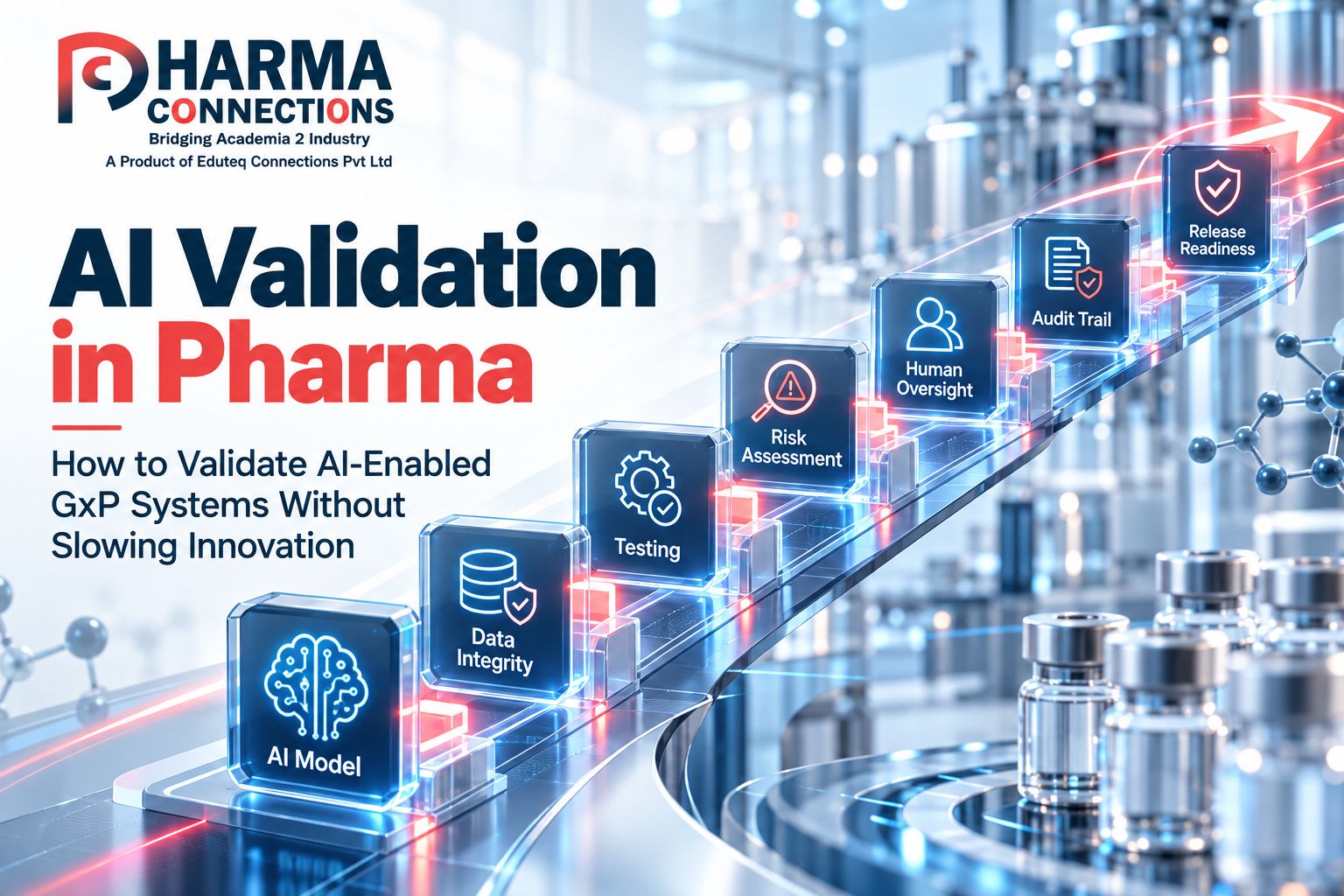
Artificial intelligence is quickly moving beyond testing into core pharmaceutical processes. AI-based applications can support…
Pharmaceutical validation teams don’t always need the same resources year-round. A business might be adequately…

Pharma Connections, Established on February 14, 2019, A Product of Eduteq Connections Pvt Ltd (An ISO 9001:2015 certified company), is dedicated to providing training and upskilling opportunities for Life science Professionals.
Read More