Breaking into the pharma industry is not as easy as having a degree. Each year, thousands of graduate pharmacists, biotechnologists, life scientists, chemists, microbiologists, and clinical workers find themselves in the labor market, and only a small part of them can even find themselves in large pharmaceutical firms. This is not due to a shortage of talent. It is deficient in the appropriate skills, articulateness, and business-capable knowledge.
The current trend in pharma recruiting is driven by experience-related skills, regulatory and workflow knowledge, documentation fluency, and the ability to deliver on day one. This is what students find the most difficult.
They are unaware of how pharma systems are operationalized, how audits are conducted, how validations are performed, how clinical trials are carried out, how safety teams are organized, and how data flow occurs. That is the first feeling of hiring managers: they are not prepared yet.
This is why Pharma Training to Placement has become a necessity. An organized training program addresses the gap between academic expectations and real industry expectations. It provides the language, tools, and mindset that companies at the top of the pharma industry want in their interviews.
Why Industry-Focused Pharma Training Is a Complete Career Breakthrough
The pharmaceutical business is immense, with rivalry over good positions being even larger. Businesses do not desire individuals who are just theoreticians. They seek candidates with knowledge of processes, compliance, documentation, and cross-functional workflows. That is where training will be your plus. It takes you out of the ranks of just an applicant iand nto a talent ready to work in the industry.
1. Training Gives You the Practical Knowledge Degrees Don’t Teach
College teaches concepts. Pharma companies require competencies. The difference between the two is enormous. During interviews, graduates may find themselves unable to answer the interviewer because they do not understand how the industry functions, including protocol requirements, the GxP system, CSV logic, data cleaning processes, PV case processing, CSA decision-making, and documentation formats.
With real explanations, this gap is bridged by our pharma training courses:
- How real systems operate, how departments communicate, how work is documented, how compliance is handled, and how companies assure quality.
- You are learning by example, scenario, template, workflow and real case – not descriptive theory.
- This realistic understanding immediately gives you confidence, and the hiring managers react to it. You begin to speak their language and that makes them feel that you are willing to act at first instance.
2. Industry-Ready Skills Make Your Profile More Attractive to Recruiters
Top pharma companies are competitive in their hiring processes. Within a week, recruiters go through hundreds of resumes. It is not only B.Pharm / M.Pharm / B.Sc / M.Sc. that attracts their attention. They seek job-specific skills:
- Clinical Data Management Knowledge.
- PV case processing basics
- CSA/CSV knowledge
- Principles of regulatory and data integrity.
- Reporting and GxP awareness.
- Validation and risk logic
- Knowledge of international procedures (FDA, EMA, ICH-GCP)
These skills are inculcated in our pharma training programs in a detailed and comprehensible manner. You will be noticed immediately when your resume reflects industry-related skills rather than general academic jargon. Recruiters like to hire applicants who need little training and can adapt to the workflow. This is why trained candidates are shortlisted more quickly.
3. Pharma Training Helps You Choose the Right Career Path
A considerable number of students are unaware of the field in which they could excel. Should they prefer Pharmacovigilance? Clinical Data Management? CSV/CSA? Regulatory Affairs? Medical Writing? Clinical Research? Quality Assurance? In the absence of clarity, they make decisions randomly, and all end up in positions they do not like or do not develop in.
We have career orientation, domain clarity, and role-based explanation in our training. You learn:
- What each domain involves
- What are daily tasks like?
- What growth ladder does it offer?
- What is the salary range that you can expect?
- What are the skills required in each domain?
This causes you to select an area that interests you and has potential. When your job aligns with your strengths, placement becomes less of a problem and long-term development becomes natural.
How Our Pharma Training Courses Prepare You for High-Paying Placements
It takes more than knowledge to be assigned to a leading pharma company. You must have confidence, clarity, communication, documentation skills, and domain knowledge. We have designed our training in such a way that you will pass all the steps of the placement process, from resume screening to the HR round.
1. You Learn Real Industry Workflows Used by Top Pharma Companies
All the fields of pharma are structured workflows. You do not learn definitions in training, you learn processes step by step:
- How PV case processing works
- Management of EDC systems by the CDM teams.
- The way CSV/CSA teams deal with validations.
- How QA/QC ensures compliance
- The way the regulatory teams prepare submissions.
- The manner in which clinical teams deal with protocol-oriented tasks.
You are not seeing the whole picture. This provides you with the actual street smart that businesses require of applicants. Walking through a workflow with a walkthrough interviewer will automatically enhance your chances of getting placed.
2. You Practice With Real Templates, Documents & Scenarios
The most significant benefit of pharma training is exposure to real documents and scenarios. You work with:
- ICSR case examples
- MedDRA / WHO-DD basics
- CRF and EDC visuals
- Checking documentation (URS, FRS, RTM)
- Risk assessment samples
- Query management flow
- Audit and compliance situations.
This experience is the reason why employers have more confidence in trained job seekers than in fresh graduates. You do not get lost in documentation, you understand how it creates the real projects. That makes you a treasure to CROs and pharma teams.
3. You Learn How to Answer Interview Questions With Logic & Structure
Pharmacology interview rounds are not only knowledge-based. They check:
- Clarity
- Reasoning
- Understanding
- Logic
- Communication
- Situational thinking
Through our training, we can teach you to dissect a question, connect it to real processes, and respond with confidence. Be it how you deal with discrepancies, what seriousness in PV is, or what risk-based testing is, you acquire answers that demonstrate competence and not memorization.
That is what can make you pass technical rounds in such companies as IQVIA, Syneos, Parexel, Labcorp, Novartis, Pfizer, and other industry giants.
4. You Get Resume Building, Mock Interviews & Placement Guidance
There are several students with knowledge, yet they fail placements because of poor resumes or nervousness during interviews. This is the reason why our training involves:
- ATS optimization of a resume using keywords.
- Resume organization Domain.
- Mock interviews (simulation-based)
- Feedback sessions
- Company targeting instructions.
- Tips for salary negotiation
- Pharma, biotech, or IT profile positioning of CRO.
These are finishing touches that make a huge difference. Placement is a logical conclusion when your resume is written correctly, and you perform well during an interview.
Pharma Connections Success Stories
- Clinical Data Associate at IQVIA
- Earlier Package: 2.8 LPA
- Following Pharma Connections Training: 7.5 LPA.
- Company Joined: IQVIA
A fresher having some problems with the simple knowledge of CRFs and trial information. She learned query logic, EDC behavior, and trial workflow clarity after training. Within 45 days of the course completion, IQVIA employed her.
- Drug Safety Associate at Parexel
- Earlier Package: 3.2 LPA
- Post-training Pharma Connections: 8.8 LPA.
- Company Joined: Parexel
He was not clear on PV case flow and medical coding. He learned and was able to articulate seriousness, causality, and narrative logic. In the first attempt, Parexel picked him.
- CSA Analyst at Accenture Life Sciences
- Earlier Package: 4 LPA
- Following Pharma Connections Training: 11.2 LPA.
- Company Joined: Accenture
A product of QA, he had a hard time penetrating digital realms. Training made him realize the risk-based testing, validation logic, and CSA. This became clear to get him a well-paid job.
- Clinical Data Reviewer at Labcorp
- Earlier Package: 5.5 LPA
- Following Pharma Connections Training: 13.5 LPA.
- Company Joined: Labcorp
She was exposed to basic EDC but with a poor theoretical background. Organized CDM training helped her upgrade quickly and get a reviewer job.
- PV Scientist at Novartis
- Earlier Package: 6.2 LPA
- Post Pharma Connections Training: 15.8 LPA.
- Company Joined: Novartis
He then passed the technical round at Novartis after learning how to analyze the quality of a case, follow up logic, and coding patterns.
Why Pharma Connections Is the Best Choice for Pharma Training for Placement
Pharma Connections is not only a training provider. It is a placement agency that aims to develop talented, competent professionals for pharmaceutical and clinical research jobs worldwide.
- Training Built on Real Project Experience
The modules are based on real-world industry practice, not theoretical summaries. You are taught about the best workflows that CROs and pharma companies use.
- Simple, Clear, Beginner-Friendly Teaching Style
Explanations are structured so that freshers do not get confused when understanding complex concepts.
- Strong Focus on Practical Understanding
You solve by example, template, documentation flow and actual trial cases.
- Placement-Oriented Approach
Resume construction, practice interviews, area advice, and firm targeting all of this is in line with placements.
- Trusted by Hundreds of Students Now Working in Top Companies
Alumni of Pharma Connection are currently employed in:
- IQVIA
- Parexel
- Syneos
- Accenture
- Labcorp
- Novartis
- Pfizer
- GSK
- ICON
- TCS Life Sciences
Conclusion
The pharmaceutical industry rewards those who are prepared and not those who apply. The best corporations seek applicants with knowledge of workflows, documentation, risk logic, and compliance-based processes. In the absence of this clarity, even bright students fail to get placements. However, when pharma training is organized, all is different.
Pharma Trainingfor Placement programs is structured to provide you with practical skills, confidence, clarity in interviews, and a thorough understanding of the domain. You do not only learn the definitions, but also the actual processes implemented by international teams. You get training on how to present yourself, how to think through technical situations, how to think, how to communicate effectively, and how to match your profile to high-paying pharma jobs.
It is time to take action, assuming you desire to work in an industry that is steadily growing, highly paid, and keeps you relevant in the global life sciences system. Enrol in Pharma Connections Pharma Training and take the first step toward collaboration with the best pharma companies.
Related Posts
How to Find Qualified CSV and CSA Professionals for GxP Projects
When pharmaceutical and life sciences companies manage regulated technology projects, they must recruit the right…
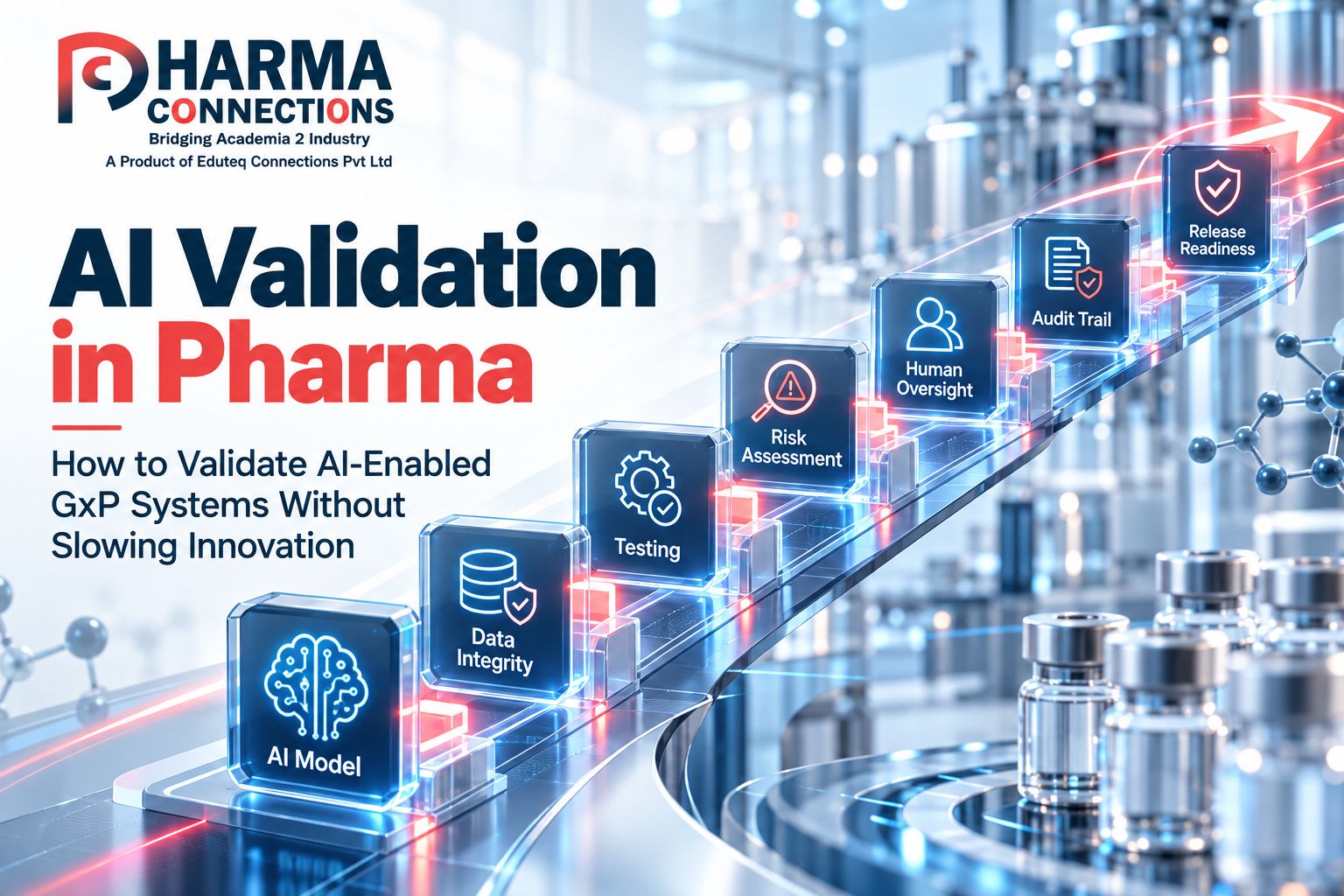
AI Validation in Pharma: How to Validate AI-Enabled GxP Systems Without Slowing Innovation
Artificial intelligence is quickly moving beyond testing into core pharmaceutical processes. AI-based applications can support…
Contract CSV resources: When Should Pharma Companies Use Contract Validation Professionals?
Pharmaceutical validation teams don’t always need the same resources year-round. A business might be adequately…