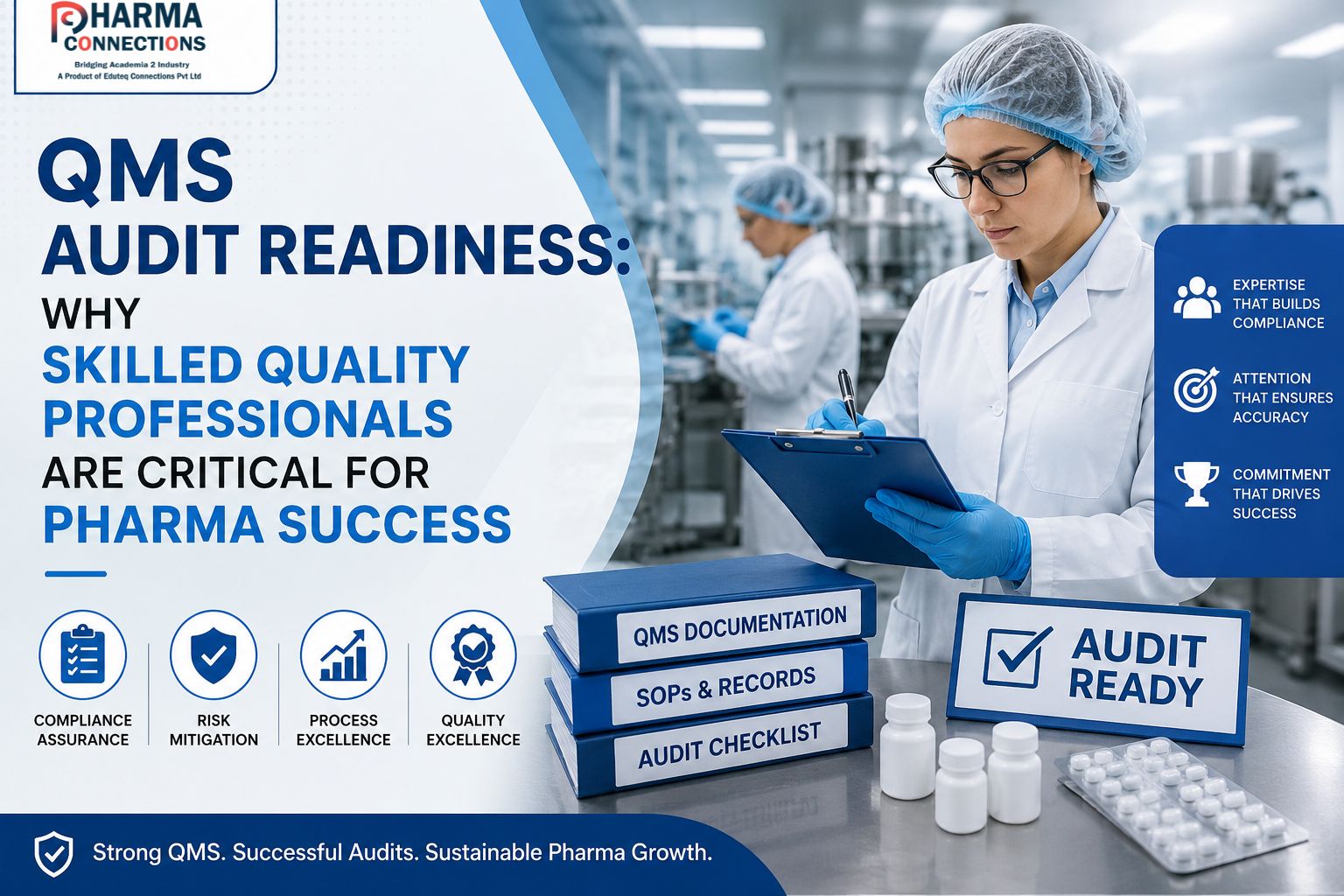
The issue of staying audit-ready for QMS has become one of the top priorities for pharmaceutical companies operating in the highly regulated environment of the modern world. Regulatory inspections, customer audits, certification assessments, and internal quality reviews now consider the effectiveness of implementing and maintaining Quality Management Systems by organizations in addition to documentation.
Consequently, organizations are investing in trained quality professionals who will help to make sure that compliance is ensured by day, not just at inspection time.
Quality Management Systems (QMS)-trained professionals assist companies with documentation, CAPA, deviations, change control, quality risk management, and continuous improvement and ensure that operations are ready for inspection year-round.
Whether you are a fresher joining the pharmaceutical sector or an existing professional seeking to advance your career, expertise in QMS audit preparedness offers promising prospects and helps organizations attain regulatory compliance and sustainable business growth.
Current pharmaceutical firms realize that inspection success is a consequence of consistent good practices rather than haphazard arrangements. To stay audit-ready, good audit systems must be maintained with discipline, proper documentation, and well-trained professionals constantly overseeing compliance action. This change has highlighted the need for skills in quality management systems and made them of great importance in pharmaceutical organizations.
The health authorities continue to raise expectations for documentation, quality systems, investigations, risk management, and data integrity. Organizations should be ready to show compliance at any level of their activities.
Being audit-ready is achieved through consistent adherence to approved procedures, rigorous documentation, and continuous observation, rather than temporary planning before the regulatory audit.
Digital documentation platforms, eQuality Management Systems and automated workflows demand professionals who are capable of upholding compliance and adequately operate on modern quality technologies.
Lack of compliance may result in regulatory observations, production delays, product recalls, higher operational costs, and reputational damage, thus making audit readiness key to the future success of any business.
Institutions with qualified QMS experts are better equipped to handle audits, as their quality systems are well-structured, adhere to standards, and are consistently maintained throughout the year.
Robust QMS audit preparedness requires professionals who are aware of how Quality Management Systems operate in real-world pharmaceutical settings. However, their role goes much deeper than ensuring paperwork, as they oversee quality processes on an ongoing basis, identify areas for improvement, and ensure compliance as part of daily operations. Their skills can help organizations plan inspections in advance without disrupting normal business operations.
When audits are conducted, quality professionals ensure that Standard Operating Procedures (SOPs), quality manuals, training records, specifications, controlled documents, and other compliance records are up to date, accurate, traceable, and readily available.
In case of quality-related problems, trained experts are involved in investigating deviations, carrying out structured root cause analysis and Corrective and Preventive Actions (CAPA), which ensure their effectiveness, and monitoring the results to ensure that a similar problem does not happen in the future.
Before any process, equipment, document, or change in a computerized system is implemented, all changes should be considered. Quality professionals maintain regulatory compliance and ensure that change control activities are assessed, documented, approved, and implemented.
The quality professionals prepare audits, organize audit documentation, assist auditors in conducting inspections, handle responses to audit observations, and assist departments in identifying corrective measures to enhance future audit performance.
Instead of concentrating on audit preparation, senior QMS professionals examine performance indicators and quality trends, identify areas for process improvement, and initiate initiatives to enhance organizational quality systems annually.
QMS audit preparation needs a balance of expertise in technical, regulatory, analytical and communication areas to be developed. Individuals who acquire these skills become valued members of the pharmaceutical organization, as they contribute to excellence in quality and consistent compliance.
Document control, CAPA, deviations, change control, in-house audits, risk quality management, complaint management, and continuous improvement are the processes that professionals need to know since these are the pillars of the successful Quality Management System.
Knowledge of the provisions of Good Manufacturing Practices (GMP), GxP principles, pharmaceutical regulations, and inspection expectations will allow the professional to conduct compliance activities with confidence and remain audit-ready.
Effective quality professionals understand how to research quality events, determine root causes, evaluate remedial actions to be undertaken, and apply preventive actions that reinforce quality systems and eliminate the risks of future compliance issues.
Keeping documentation in order and effectively communicating with cross-functional teams, auditors, and management are crucial abilities for facilitating successful inspections and managing quality.
New Quality Management Systems have proactive risk management. The presence of professionals with knowledge of potential quality risks and the ability to set priorities and make well-considered compliance decisions would enable organizations to maintain audit readiness and enhance their performance.
Pharmaceutical enterprises realize that good quality systems are built by competent professionals who consistently uphold compliance, rather than merely preparing in advance for checks.
The use of employees who have expertise in QMS audit preparedness assists organizations in reducing regulatory risks, enhancing the performance of the organization, and gaining confidence during the audit period. This makes them important contributors to manufacturing, quality, and compliance functions, as well as to leadership functions.
Organizations would prefer people with quality procedures in their daily routine rather than those who prepare audits at the last minute. This method keeps its documentation up to date, maintains practices in control, and delivers compliance evaluations that meet regulatory expectations throughout the year.
Those possessing adequate quality skills can spot any compliance loopholes prior to the occurrence of a significant problem, and this aids companies in preventing regulatory observations, production disruptions, product recalls, and expensive corrective measures.
An effective quality culture must rely on highly motivated staff members who advance accountability, promote process compliance, advance ongoing education, and prudently urge groups to hold the utmost quality measures over all departments.
Close coordination among Quality Assurance, Manufacturing, Engineering, Validation, Warehousing, Supply Chain, and Regulatory Affairs is essential to maintain audit preparedness. The relevant QMS professionals make sure that these departments operate in liaison with each other and that there is always compliance.
Effective Quality Management Systems enhance customer confidence, build regulatory relationships, contribute to operational efficiency, and facilitate long-term business growth; effective quality professionals are often worthy investments in the long run.
Pharma Connections offers professionals the ideal place to gain knowledge in QMS audit preparation and to build an established career in pharmaceutical quality management. The training programs will be aimed at offering practical knowledge, real-world exposure, and industry-oriented learning that helps professionals to manage quality systems with a lot of confidence and be capable of supporting regulatory inspections.
Quality Management Systems, GMP, CAPA, deviations, change control, document control, internal audits, quality risk management, regulatory compliance, and continuous improvement are already covered in the curriculum, based on current practices in the pharmaceutical industry.
Students gain practical experience in audit documentation, inspection preparation, compliance processes, quality investigations, and industry case studies that reflect real-world pharmaceutical quality processes.
The knowledgeable pharmaceutical experts are well positioned to offer a practical approach to quality systems, regulatory compliance, audit preparation, compliance management, and quality leadership, enabling learners to gain insight into how QMS works in real-world organizations.
These programs incorporate industry best practices, computerized Quality Management Systems, evolving regulatory demands, and new approaches to quality that help professionals keep pace with the rapidly evolving pharmaceutical landscape.
Pharma Connections assists and elevates learners by enhancing technical skills, supporting interview preparation, building confidence, and preparing for rewarding careers in quality management, compliance, and pharmaceutical management.
The need to keep QMS audit-ready is no longer an activity performed prior to inspections. It is a continuous process that requires robust quality systems, disciplinary processes, proper documentation, and competent professionals who can uphold compliance on a daily basis. The need for qualified QMS professionals will continue to rise as more pharmaceutical companies are subject to increasingly stringent regulatory standards and adopt digital quality systems.
For professionals, more than just technical expertise can be gained through the development of expertise in Quality Management Systems. It develops applied competencies that enhance employability and career stability, provide leadership opportunities, and allow users to make meaningful contributions to pharmaceutical quality and compliance.
Pharma Connections can offer the most effective guidance and practical training in QMS audit preparation for professionals who wish to have successful pharmaceutical careers.
We provide the knowledge and confidence needed to assist in inspection, bolster quality systems, and excel in the regulated pharmaceutical industry today through industry-oriented programs, professional trainers, real-world case studies, and career-oriented learning.
QMS audit readiness is the ability of a pharmaceutical organization to maintain compliant quality systems, accurate documentation, and effective processes, and to remain prepared for regulatory inspections at all times.
They maintain quality documentation, manage CAPA, investigate deviations, oversee change control, support audits, and continuously improve quality systems to ensure ongoing regulatory compliance.
Important skills include Quality Management Systems, GMP, CAPA, deviation management, change control, internal auditing, documentation, quality risk management, and regulatory compliance.
Freshers, QA professionals, QC personnel, production professionals, supervisors, compliance specialists, and anyone planning a career in pharmaceutical quality management can benefit from this training.
Pharma Connections provides practical, industry-focused QMS training that helps professionals build compliance expertise, improve audit readiness, strengthen employability, and prepare for long-term career growth in the pharmaceutical industry.
The future of validation careers has never been more promising, with pharmaceutical companies ever accelerating…

Pharma Connections, Established on February 14, 2019, A Product of Eduteq Connections Pvt Ltd (An ISO 9001:2015 certified company), is dedicated to providing training and upskilling opportunities for Life science Professionals.
Read More