The pharmaceutical industry now views pharmacovigilance as a major career opportunity. Drug safety drives global healthcare systems today. Companies must hire specialists who track negative drug reactions, assess risk versus benefit, protect patient health, and meet worldwide regulatory standards.
This rising need created opportunities for professionals seeking quick advancement. Strong pay packages await qualified candidates. Global job openings multiply daily. Career stability looks guaranteed for years ahead.
Here’s what makes this interesting. Years of work experience aren’t required to start in pharmacovigilance. You need clear concept knowledge instead. Real-world process understanding matters most. Industry-ready abilities open doors immediately. Quality pharmacovigilance courses let you jump straight into high-paying positions. These roles provide excellent visibility. International exposure comes standard. Salaries exceeding 15 LPA become achievable after just a few job changes.
Pharma Connections transformed this landscape completely. Our students moved from underpaid QA/QC jobs into powerful PV positions. Documentation roles got left behind. Global MNCs hired our graduates. Salary increases ranged from 4 LPA to 15–22 LPA. These jumps happened within short timeframes.
Why the Pharmacovigilance Course Is a Career Breakthrough
Side-effect detection is just one small piece of pharmacovigilance. This field covers multiple layers of work. Patient safety comes first. Regulatory submissions happen constantly. Risk communication requires expertise. Global medical reviews demand attention. Compliance never stops. This complexity makes PV highly respected. Pay scales reflect this importance throughout pharma.
1. Pharmacovigilance Professionals Are in Global Demand
Pharmaceutical companies worldwide depend heavily on PV teams. The US market needs drug safety experts. European firms are constantly. UK companies seek qualified specialists. India’s pharma sector grows rapidly. Emerging markets expand their operations. Product safety and compliance require dedicated professionals.
Clinical trials are increasing worldwide. Drug approvals happen faster than before. The need for drug safety specialists grew explosively. Companies now build massive PV departments. Safety operations get outsourced frequently. Round-the-clock global safety monitoring operates continuously. All of this requires trained people.
Quality pharmacovigilance courses teach immediately relevant skills. Global demand connects directly to what you learn. Case processing becomes second nature. MedDRA coding gets mastered. Narrative writing develops properly.
Aggregate reporting makes sense. Signal detection becomes clear. Each ability links to quality job openings. This demand creates faster interview callbacks. Hiring cycles speed up dramatically. Skilled PV professionals receive strong compensation offers.
2. PV Roles Offer Faster Career Growth Than Traditional QA/QC
QA and QC remain necessary functions. Career progression often moves slowly in these areas, though. Exposure stays limited. Pharmacovigilance provides clear advancement stages instead. You start as a Drug Safety Associate. Safety Scientist comes next. Medical Reviewer positions open up. Signal Detection Specialist roles appear. Risk Management Expert represents the peak.
This career pathway follows clear structures. Global recognition supports every stage. Regulatory updates happen continuously. Solid pharmacovigilance courses help you enter confidently. Growth happens faster than traditional roles allow. Just a few years bring major upgrades. PV professionals move from entry positions to senior global roles quickly. Salaries crossing 15–20 LPA become normal. Performance and expertise determine final compensation.
3. PV Gives You Access to International Projects and Remote Opportunities
Pharmacovigilance stands apart from other pharma domains. Your physical location creates no barriers here. Drug safety teams work across borders naturally. Cases get handled from multiple regions simultaneously. This creates huge opportunities for remote work. Hybrid profiles become available. Overseas placements happen regularly.
Companies want professionals to understand global guidelines. FDA regulations matter. EMA standards apply. MHRA requirements exist. CDSCO rules govern India. ICH E2A through E2E provide frameworks. MedDRA knowledge proves essential. Quality pharmacovigilance courses that cover these regulations fully prepare you.
International projects become accessible immediately. Many professionals transition into EU positions after gaining experience. US-based PV roles attract experienced workers. Salaries rise quickly due to global pay structures.
How a Pharmacovigilance Course Helps You Secure a 15 LPA+ Package?
Experience alone doesn’t create high pharma salaries. Skills directly supporting regulatory compliance generate strong pay. Pharmacovigilance values competence over tenure. This makes it unique.
1. You Gain Expertise in Case Processing — the Highest-Demand PV Skill
Case processing forms pharmacovigilance’s foundation. Work involves collecting adverse event data. Assessment follows strict protocols. Coding uses global standards. Reporting follows worldwide guidelines. Companies prioritize candidates who handle ICSRs properly. Individual Case Safety Reports demand accuracy. Compliance cannot slip. Speed matters significantly.
Quality pharmacovigilance courses teach:
- Serious versus non-serious case identification
- MedDRA coding logic
- Narrative writing techniques
- Literature screening
- Follow-up procedures
- E2B submission fundamentals
Case processing mastery makes you eligible for high-paying roles instantly. Most professionals upgrading this capability see major jumps. Moving from 3–5 LPA to 10–18 LPA happens within one to three job changes. Performance matters. Company size affects packages. Project exposure determines growth.
2. You Stand Out in Interviews With Strong Regulatory Knowledge
PV candidates must understand guidelines deeply. Companies expect this knowledge. Most applicants struggle without training. Basic explanations fall apart beyond simple definitions. Employers prefer logical thinkers who can explain:
- ICSR lifecycle
- Aggregate reporting
- Risk management planning
- Signal detection
- E2B(R3) submissions
- FDA and EMA expectations
Structured pharmacovigilance courses naturally build this clarity. Interview answers gain confidence. Maturity shows through responses. Real understanding replaces memorised content. This positions you for higher packages immediately. Selection happens faster.
3. PV Training Builds Skills for High-Value Roles Like Signal Detection
Signal detection and risk management represent advanced PV areas. These positions pay significantly higher salaries. Strong analytical skills become necessary. Regulatory alignment proves critical. Interpreting safety patterns from global data sources requires expertise.
Proper training helps you move beyond basic case processing. High-impact positions become accessible. These command 15–25 LPA salaries. Employers reward professionals identifying trends successfully. Risk signal raising matters greatly. Regulatory decision-making support proves valuable. These skills influence patient safety directly. Company reputation depends on this work.
4. Real-Time Scenarios Prepare You for High-Level Responsibilities
Quality pharmacovigilance courses use real-world examples. Mock cases develop practical skills. Sample narratives teach proper writing. Safety databases become familiar. This hands-on approach builds practical expertise. You learn exactly how PV teams operate inside MNCs.
This practical understanding helps you:
- Perform better in interviews
- Handle responsibilities confidently
- Move into senior roles faster
- Demand higher compensation
Professionals with practical exposure rarely stay below 12–15 LPA. A few years of consistent performance guarantee strong packages.
What You Learn in a Strong Pharmacovigilance Course
Powerful pharmacovigilance courses go beyond definitions. Basic ADR reporting isn’t enough. Real-world drug safety work gets prioritized. Global companies expect specific capabilities when hiring PV professionals at 12–15 LPA packages.
Strong PV programs build solid foundations. Analytical thinking gets strengthened. Regulatory understanding sharpens considerably. Training covers systems used by top pharma companies daily.
This separates low-value certifications from career-transforming pharmacovigilance courses.
High-quality PV courses should teach you exactly what appears below.
1. Complete Understanding of Adverse Drug Reactions and Drug Safety Principles
Structured PV courses begin with fundamentals. Adverse events happen for specific reasons. Classification systems exist for organizing them. Global authorities take safety extremely seriously. You understand drug safety across entire product lifecycles. Clinical trials represent one phase. Post-marketing surveillance continues indefinitely. This builds scientific and logical foundations for future work.
You learn:
- Types of ADRs (serious, non-serious, expected, unexpected)
- Causality principles and medical assessment basics
- ICSR components and quality expectations
- Role of medical reviewers and safety physicians
This provides the base required for handling safety data confidently.
2. Mastery of ICSR Case Processing End-to-End
This forms any pharmacovigilance job’s backbone. Strong courses teach it with complete clarity. Processing individual case safety reports follows step-by-step procedures. Accuracy cannot slip. Completeness gets verified. Compliance with regulatory timelines stays mandatory.
Key components you learn:
- Case triaging
- Validity checks
- Data entry and narrative writing
- Coding using MedDRA terminologies
- Case quality review
- Submission checks
- Follow-up and reconciliation
Good courses teach both steps and logic behind each step. This helps you crack interviews. Work efficiency starts from day one.
3. Hands-On Exposure to PV Databases and Tools
Strong PV courses expose you to real drug safety department systems. This helps candidates transition directly into 10–15 LPA roles. Companies want people working efficiently in structured digital environments.
You learn about:
- Argus Safety
- ArisGlobal (Lifesphere)
- Safety databases and workflows
- Signal detection dashboards
- QMS and document systems
Basic tool familiarity provides huge advantages. Many candidates know only theoretical concepts. System workflows remain mysterious to them.
4. End-to-End Knowledge of Global PV Regulations
Rules run the pharma world. FDA governs America. EMA controls Europe. CDSCO manages India. MHRA oversees Britain. PMDA handles Japan. Health Canada sets standards. WHO provides global guidance. Strong PV courses make you comfortable with all major regulatory landscapes. Indian and global clients become accessible employers.
You learn regulatory expectations like:
- E2B (R3) reporting standards
- GVP Modules (Volume IX)
- 21 CFR Part 314.80 requirements
- Indian PvPI reporting structure
- PSUR/PBRER fundamentals
This regulatory fluency is most valued by interviewers.
5. Narrative Writing and Medical Assessment Basics
Narrative writing ranks among PV’s most important skills. Good courses teach clear, accurate, regulator-ready narrative crafting. You understand what information matters. Clinical detail interpretation becomes natural. Medical coherence gets ensured.
Strong PV courses help you learn:
- How to extract key information from medical documents
- How to structure a narrative properly
- How to ensure clinical consistency
- How to avoid compliance risks in narratives
Strong narrative writing skills alone push packages from 7–8 LPA into the 12–15 LPA range.
6. Signal Detection and Risk Management Planning
Mid-senior PV roles depend heavily on risk management. Strong PV courses introduce early-level signal detection concepts. Global systems track emerging safety concerns continuously.
You learn fundamentals of:
- Signal identification
- Aggregate reporting
- Trend analysis
- RMP structure and components
- Risk mnimization activities
This provides long-term career leverage. Companies prefer candidates understanding both ICSR and aggregate safety.
Pharma Connections Success Stories
Students joining Pharma Connections for Pharmacovigilance training enter more than just a course. They join a system designed for lifting confidence. Knowledge gets sharpened systematically. Positioning for high-paying PV, drug safety, and clinical compliance roles happens naturally.
These success stories demonstrate learners moving from low-paying packages to 15 LPA+ jobs. Top multinational company interviews got cracked. Clarity, structure, and practical understanding gained through Pharma Connections made the difference.
1. Drug Safety Associate at Cognizant
Earlier Package: 3.6 LPA
After Taking Pharma Connections Course: 15.2 LPA
Company Joined: Cognizant
Basic PV concepts caused struggles initially. This learner turned to Pharma Connections for understanding case triage. Narrative writing became clear. MedDRA coding made sense. ICSR processing got mastered. Cognizant’s interview panel appreciated her strong seriousness assessment understanding. Expedited reporting timelines got explained confidently. Real-world PV scenario explanations impressed them. Signal detection basics showed well. Her 15.2 LPA role as Drug Safety Associate resulted from this preparation.
2. PV Process Specialist at Accenture
Earlier Package: 4.8 LPA
After Taking Pharma Connections Course: 18 LPA
Company Joined: Accenture
Documentation-heavy jobs trapped him. Almost no exposure to drug safety work existed. Pharma Connections helped him master AE reporting. CIOMS forms became familiar. Regulatory timelines got internalized. Case quality checks became second nature. Accenture’s life sciences division appreciated his structured causality assessment approach. The follow-up process understanding showed clearly. An 18 LPA package landed. End-to-end ICSR processing for EU markets has become his work now.
3. Safety Data Analyst at Novartis
Earlier Package: 6 LPA
After Taking Pharma Connections Course: 20 LPA
Company Joined: Novartis
Clinical background knowledge existed despite PV entry struggles. Pharma Connections provided clarity on aggregate reporting. DSURs made sense. PADERs became understandable. Signal detection flow got mapped. Safety databases like Argus and ARISg became familiar. Novartis selected him for a 20 LPA role. Case lifecycle management got explained confidently. Regulatory expectations for different regions showed mastery. His transition became remarkably impressive.
4. Pharmacovigilance Associate at Parexel
Earlier Package: 2.4 LPA
After Taking Pharma Connections Course: 16 LPA
Company Joined: Parexel
A fresher earning 2.4 LPA learned the entire PV workflows through the course. Case intake became clear. Data entry was practised. Narrative writing has developed properly. Medical review coordination made sense. Global reporting rules got memorized. Quality checks became routine. Parexel appreciated the seriousness criteria clarity. The follow-up technique impressed them. The transformation from a fresher to a 16 LPA PV professional became a strong highlight for Pharma Connections.
5. Safety Operations Specialist at IQVIA
Earlier Package: 5.2 LPA
After Taking Pharma Connections Course: 19 LPA
Company Joined: IQVIA
Stagnant growth lasted for years. Domain switching required PV course enrollment. Pharma Connections helped her understand line listings. Reconciliation became clear. Aggregate report preparation has been mastered. Regulatory intelligence has developed properly. IQVIA valued her ability to explain expectedness assessments. Case prioritization showed a strong understanding. A 19 LPA offer arrived. This represented a significant increase over the previous salary.
6. Senior PV Analyst at Dr. Reddy’s
Earlier Package: 7 LPA
After Taking Pharma Connections Course: 22 LPA
Company Joined: Dr. Reddy’s
Clinical operations to PV movement seemed desirable. Structured knowledge remained lacking, though. Pharma Connections trained him on signal detection frameworks. Risk–benefit analysis became clear. QPPV activities were understood. Literature screening was developed properly. Medical monitoring made sense. Dr Reddy’s offered a 22 LPA package. Global PV guideline command got evaluated. Process alignment showed excellence.
Conclusion
Drug safety worldwide now depends on pharmacovigilance as its heartbeat. Companies constantly search for professionals understand AE reporting. Regulatory timelines need mastery. ICSR quality matters greatly. Narrative writing requires confidence. Signal detection becomes critical. Strong PV certification provides leverage for stepping into high-paying roles. Promotions come faster. Careers grow steadily across global markets.
Pharma Connections emerged as the most trusted PV training platform. Practical case studies blend naturally. Real-world regulatory requirements get covered. Interview preparation happens systematically. End-to-end job support continues throughout. Every module shapes your thinking. Understanding gets sharpened continuously. Positioning for high-impact PV roles across top MNCs becomes natural.
Your goal is to unlock 15 LPA+ opportunities. Technical foundations need strengthening. Entering the real world of drug safety requires clarity and confidence. Pharma Connections becomes the only name you need to remember. Your journey to a high-paying PV career starts here.
FAQs
1. How does a pharmacovigilance course help me secure a 15 LPA+ package?
Strong PV courses build practical knowledge in ICSR processing. AE assessment becomes clear. Regulatory timelines get memorized. Case quality improves. Companies value skill over experience. Right training helps you outperform others in interviews. High-paying roles in global PV teams become far more accessible.
2. Can freshers also earn 15 LPA+ after pharmacovigilance training?
Yes. Many freshers secure 12–18 LPA roles. Strong PV fundamentals get demonstrated. Clear process understanding shows. Confidence during interviews matters. Structured training fills knowledge gaps that freshers typically struggle with. Drug safety operations roles get secured faster than expected.
3. Which companies hire pharmacovigilance professionals with high packages?
Top companies like Novartis hire continuously. IQVIA recruits regularly. Parexel seeks talent. Accenture needs specialists. Cognizant employs many. Dr. Reddy’s hires frequently. Covance offers positions. Multiple global CROs recruit PV professionals for ICSR processing roles. Aggregate reporting needs experts. Signal detection requires specialists. Quality review demands professionals. Many offer 15–22 LPA packages.
4. What skills do recruiters look for in PV interviews?
Recruiters expect clarity on case intake steps. Seriousness assessment needs understanding. Causality requires explanation. Narrative writing shows competence. MedDRA coding demonstrates knowledge. Regulatory timelines prove awareness. Quality checks matter greatly. Signal detection basics get tested. Strong communication helps. Accuracy counts. Safety database understanding plays a key role in final selection.
5. Why choose Pharma Connections for pharmacovigilance training?
Pharma Connections offers practical PV training. Real case examples get used. Process-level clarity develops. Expert mentoring continues throughout. Job-focused preparation happens systematically. Their students consistently crack 15–20+ LPA roles across global MNCs. This makes it one of the most effective platforms for building a high-paying career in drug safety.
Related Posts
How to Find Qualified CSV and CSA Professionals for GxP Projects
When pharmaceutical and life sciences companies manage regulated technology projects, they must recruit the right…
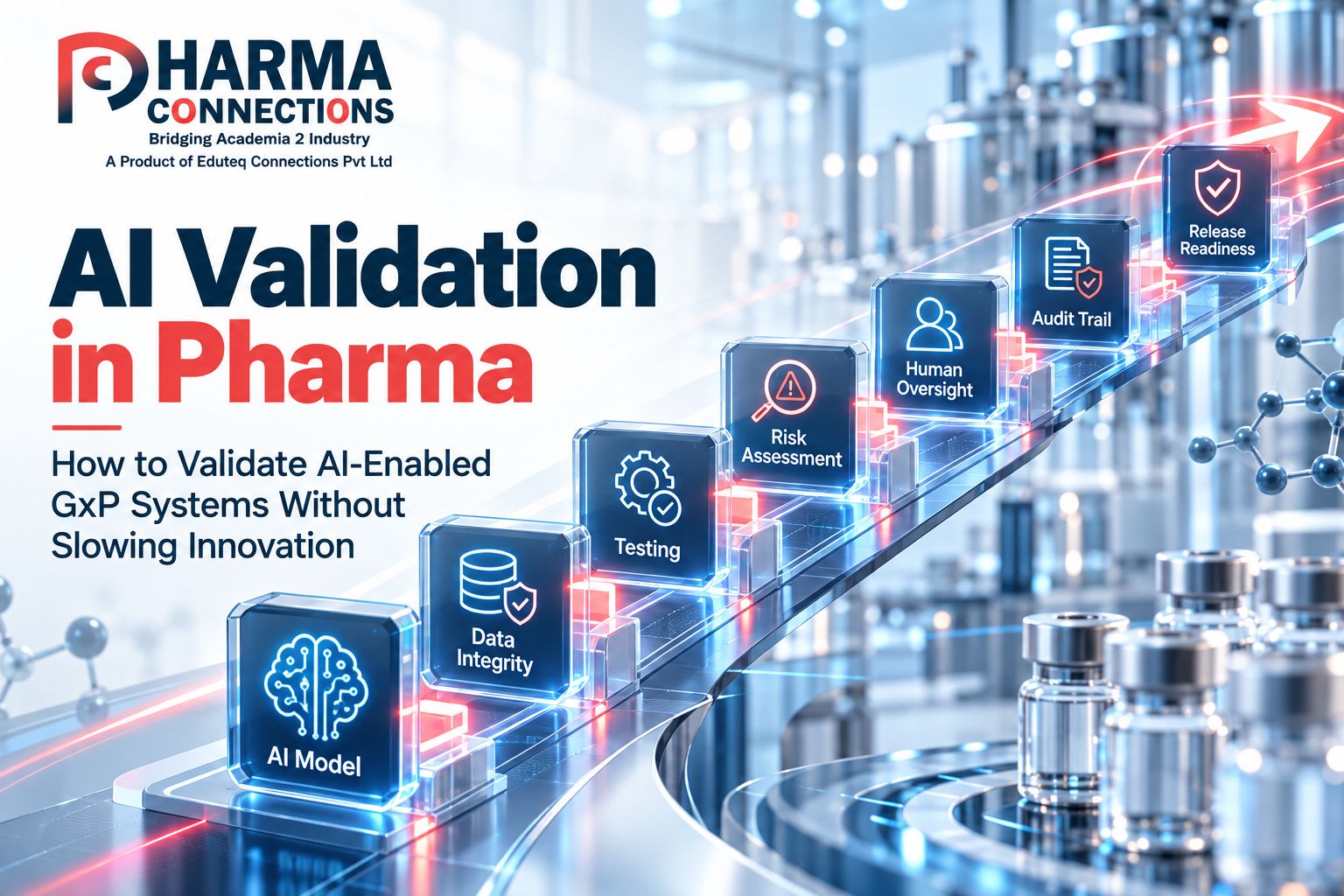
AI Validation in Pharma: How to Validate AI-Enabled GxP Systems Without Slowing Innovation
Artificial intelligence is quickly moving beyond testing into core pharmaceutical processes. AI-based applications can support…
Contract CSV resources: When Should Pharma Companies Use Contract Validation Professionals?
Pharmaceutical validation teams don’t always need the same resources year-round. A business might be adequately…