QMS leadership competencies help working professionals transition from operational roles to supervisory, managerial, and quality leadership roles. Quality Management System training contributes to expertise in compliance, CAPA management and documentation control, risk assessment and audit readiness, and process improvement, and enhances decision-making and team management.
Pharmaceutical companies are increasingly seeking professionals able to oversee quality systems, lead interfunctional initiatives, uphold compliance standards, and support continuous improvement programs.
Employees with high-level QMS knowledge are likely to have more responsibilities related to quality management, operational coordination, and regulatory compliance.
Regardless of whether your organization is in QA, QC, manufacturing, validation, or compliance, QMS training will enhance your professional credibility, broaden your career opportunities, and equip you with highly marketable skills to advance into a management role in a pharmaceutical/life sciences organization.
The pharmaceutical industry is changing rapidly, imposing new demands on professionals seeking to advance their careers.
Businesses need leadership that enables them to balance operational efficiency, regulatory compliance, and quality demands.
Contemporary organizations have to manage numerous systems, departments, technologies, and compliance requirements simultaneously.
Efficient leaders help teams adhere to procedures, documentation requirements, and initiatives for continuous improvement.
Audits and inspections tend to assess not only processes but also quality culture and management control.
Leadership functions are becoming increasingly coordinated across QA, QC, manufacturing, validation, regulatory affairs, and compliance teams.
These considerations make QMS leadership skills highly useful to professionals seeking long-term career development.
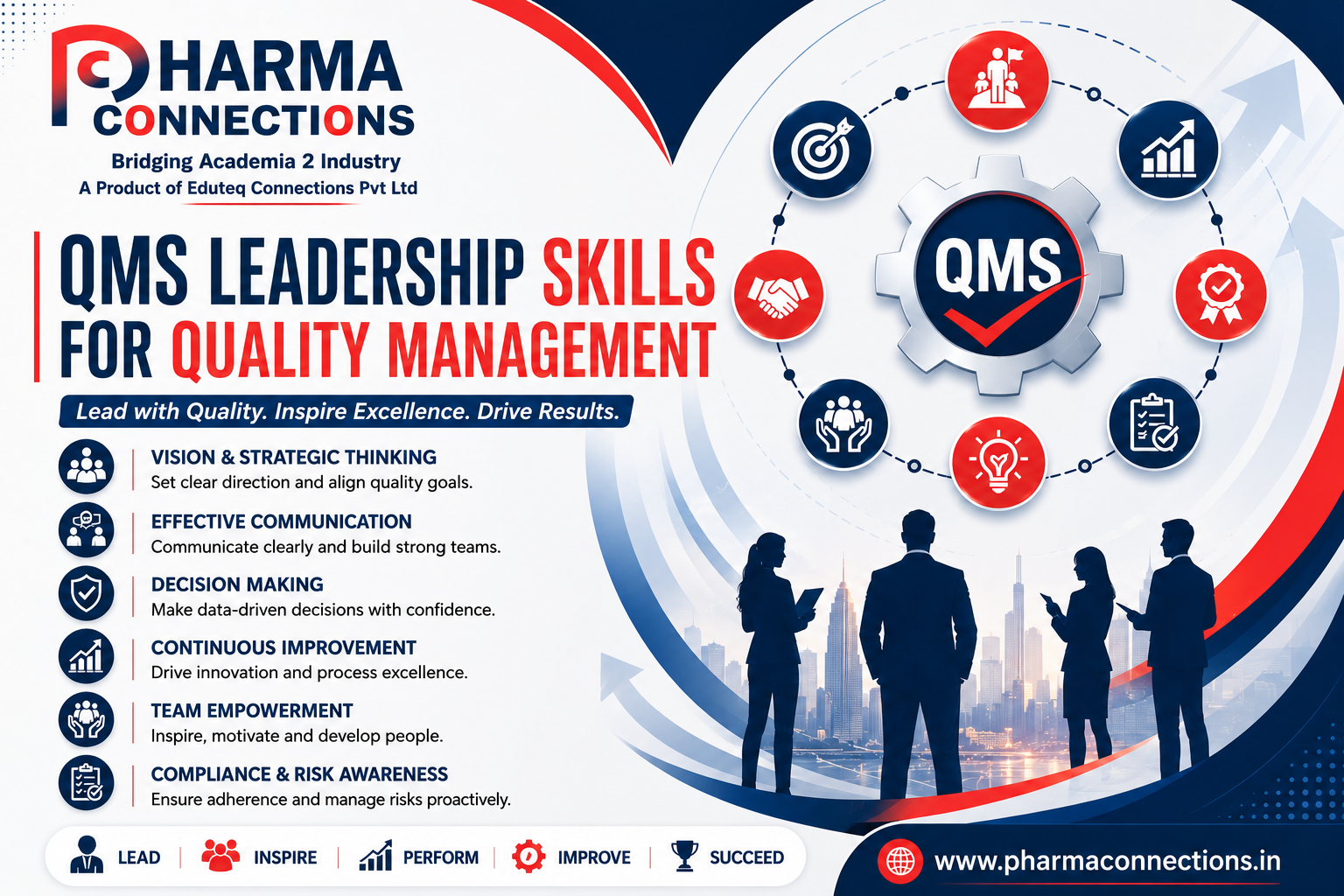
Leadership skills in the Quality Management System integrate technical compliance knowledge with managerial and strategic abilities.
Leaders should learn how quality processes can contribute to regulatory compliance and operational excellence.
Leadership is a decision-making process that involves quality and regulatory impact.
Effective leaders recognize operational risks and implement corrective measures early.
Good leaders provide a context in which quality and compliance will be group responsibilities.
Leaders help organizations in identifying opportunities on how to improve processes and performance.
The competencies are the basis of an effective leader in controlled settings.
It takes more than technical expertise to move to leadership positions. The professionals should be in a position to manage individuals, make well-informed decisions, ensure compliance, and enhance operational performance. In this situation, the QMS leadership capabilities come into play. Quality Management System training assists professionals in acquiring technical and management skills that enable them to lead their teams and take on quality-oriented responsibilities.
QMS training educates professionals in compliance, quality, and risk-based thinking to assess situations. This assists upcoming leaders in making wise decisions that support operational effectiveness and regulatory compliance.
Leadership is a process that involves uncovering problems, determining their sources, and taking corrective measures. QMS training provides structured problem-solving skills grounded in CAPA management, deviation management, and continuous improvement processes.
The leaders commonly collaborate with Quality Assurance, Manufacturing, Validation, Regulatory Affairs, and Compliance teams. The training on QMS helps specialists understand how the various departments relate to one another and how collaboration can be managed effectively.
Leaders are appreciated in the organization who can recognize the potential risks before they lead to serious concerns. QMS training enhances skills in risk assessment and preventive decision-making, which are essential in leadership roles.
Individuals with good QMS knowledge are typically relied on to conduct audits, document reviews, compliance program reviews, and quality improvement projects. This experience gives the self-confidence needed to assume supervisory and managerial duties.
Being a successful leader means not only achieving goals but also inspiring others. They should lead teams, be quality assurers, compliance assurers, and instill a culture of accountability. QMS training assists working professionals in building these leadership attributes by increasing their capacity to handle individuals and procedures as well as quality-based duties successfully.
Quality Assurance, Manufacturing, Regulatory Affairs, Validation, and Compliance are among the teams regularly engaged by QMS-trained professionals. This exposure enhances communication and makes leaders better able to coordinate activities across various departments.
Ownership and responsibility are used to build quality systems. QMS training helps professionals to define clear expectations and performance monitoring and promote a sense of accountability among the team members.
Common issues that team leaders encounter include deviations, missing documentation, process failures, and other operational issues. QMS training provides organized methods for investigating and resolving problems, eliminating repetition.
Effective leaders make teams realize that compliance, documentation accuracy, and process discipline are important. Knowledge of QMS helps professionals advance uniform quality standards in day-to-day operations.
A professional who has attained strong leadership skills in the QMS is in a position to track the workflow, identify areas for improvement, support employee development, and initiate a continuous improvement process that benefits not only the team and the organization.
Quality Management System training covers several areas that directly contribute to leadership development.
Leaders must understand controlled documentation systems. Professionals learn how documents are created, approved, and maintained. Proper documentation supports operational stability and audit readiness.
CAPA and Deviation Management
Leadership often involves overseeing investigations and corrective actions. Training develops analytical problem-solving skills. Professionals learn how to prevent recurring issues.
Risk Management and Quality Planning
Risk-based thinking is increasingly important in leadership roles. Professionals learn structured risk assessment methodologies. Leaders become more proactive rather than reactive.
Audit Readiness and Inspection Management
Leaders frequently interact with auditors and inspectors. QMS training helps professionals understand inspection expectations. Leaders gain confidence during audit activities.
Benefits of QMS Leadership Skills for Working Professionals
With increased focus on the culture of quality, excellence in compliance, and operational efficiency, pharmaceutical companies tend to prioritize professionals with strong QMS skills; hence, they offer a good boost to their career development. Such skills assist people in outgrowing their regular duties and placing them in higher-impact leadership roles within the organization.
Organizations tend to advance professionals who are capable of administering quality systems, leading teams, contributing to compliance projects, and advancing business goals. QMS leadership abilities demonstrate a willingness to take greater responsibility.
Management decisions regarding compliance, process improvement, risk management, and operational performance often involve professionals with strong knowledge of quality management systems.
QMS-trained professionals are considered reliable on quality-related issues. Being able to interpret compliance needs and manage teams is a step to gaining the trust of management and other group members as well.
Leadership demands skills to organize, guide performance, resolve issues, and minimize quality issues. QMS training helps professionals attain these fundamental management skills.
Quality and compliance functions are still vital in all pharmaceutical organizations. Companies that have professionals possessing advanced QMS leadership skills remain valuable as they take on regulatory compliance, audit preparedness, and continuous improvement initiatives.
Professionals with strong QMS leadership skills can pursue various opportunities for advancement.
Organizations increasingly recognize the value of leaders who understand quality systems.
Pharma Connections: Best Destination for Building QMS Leadership Skills
Pharma Connections is an optimal QMS training and leadership-based learning provider for pharmaceutical professionals interested in advancing beyond operations and developing successful careers in quality management, compliance, auditing, and team leadership. The programs will also assist professionals in gaining practical skills in QMS leadership, meeting real-time industry expectations and supporting long-term professional growth.
The training programs are based on practical pharmaceutical quality systems, as a result of which professionals gain knowledge of compliance management, documentation control, CAPA processes, audit readiness, and quality leadership requirements.
The participants will gain practical experience with quality management workflows and will be able to apply leadership principles in the controlled pharmaceutical setting with confidence.
The curriculum focuses on nurturing decision-making, problem-solving, compliance supervision, and team management skills needed in supervisory and management roles.
Experienced trainers who possess good pharmaceutical backgrounds teach professionals valuable lessons about leadership issues, quality expectations, and the best practices in compliance.
Pharma Connections helps professionals strengthen QMS leadership skills, improve promotion opportunities, enhance workplace credibility, and prepare for leadership roles across the pharmaceutical industry.
The Pharmaceutical industry is increasingly open to leaders who are knowledgeable about quality systems, compliance, and operational excellence. Technical knowledge is no longer sufficient. Organizations need people who can lead teams, manage risk, support audits, drive improvements, and maintain high-quality cultures.
That is why the skills of QMS leadership are now a useful instrument of a working professional who wants to advance his/her career. Quality Management System training enables professionals to acquire the decision-making, problem-solving, communication, and compliance skills needed in the leadership game. Not only do these skills enhance performance in the workplace, but they also open up avenues to supervisory, managerial, and strategic functions.
Pharma Connections is a QMS Training provider that promotes the development of these capacities in professionals by providing practice-based, industry-oriented QMS training grounded in real pharmaceutical operations.
Investing in QMS training can be an effective way to support long-term career growth and professional success for professionals who have been in a rut of routine and have now stepped out to take on the challenges of becoming a leader.
QMS leadership skills combine knowledge of quality management, understanding of compliance, risk management, and team leadership capabilities.
Yes. QMS training develops the compliance, decision-making, and process management skills often required for leadership positions.
Working professionals in QA, QC, manufacturing, compliance, validation, and regulatory functions can benefit significantly.
They help maintain compliance, support audits, improve processes, and strengthen quality culture across organizations.
Common opportunities include Quality Manager, Compliance Manager, Quality Systems Manager, QA Supervisor, and Operational Excellence Leader.
Good CSV and CSA are now among the most sought-after distinctions for those seeking a…
The future of validation careers has never been more promising, with pharmaceutical companies ever accelerating…
One of the largest reasons that professionals are considering Computer System Validation (CSV) and Computer…
The value of QMS compliance training has taken an enormous turn, becoming one of the…

Pharma Connections, Established on February 14, 2019, A Product of Eduteq Connections Pvt Ltd (An ISO 9001:2015 certified company), is dedicated to providing training and upskilling opportunities for Life science Professionals.
Read More