Pharmaceutical companies are accelerating their digital transformation. There is an increasing interconnection of quality systems, manufacturing systems, laboratory systems, and compliance platforms. However, along with this transformation comes a new challenge: how do you manage multiple GxP applications effectively without increasing compliance risk?
An AI orchestrator is not a layer of software. It is a brain-like control engine that interconnects systems and automates workflows, manages risks, and enhances decision-making in controlled settings. Pharma companies can also rely on AI orchestration to automate quality operations, validation workflows, deviations, CAPA, and audit preparation, rather than maintaining systems manually.
However, the use of AI in controlled systems must achieve a high level of compliance. This is where Computer System Validation Services, Computer System Validation, and CSA-based consulting come into play.
This article describes how an AI orchestrator functions in GxP settings, its value generation, the impact of compliance, and why validation is more significant than ever.
A GxP application AI orchestrator is a smart workflow engine that integrates and controls various regulated systems with automation, analytics, and decision-making support. Rather than operating in closed systems:
AI orchestration connects them together.
Its role includes:
This makes pharma operations quicker but still subject to regulatory control.
Pharma companies operate by GxP applications. They manage quality systems, manufacturing documentation, laboratory documentation, document workflow, and compliance activities. However, as companies grow, such systems become more complex, less integrated, and harder to operate manually. Therein, it is necessary to have an AI coordinator for GxP applications. It provides intelligent coordination among systems, minimizes operational gaps, and enhances compliance without slackening execution.
The contemporary pharma business is based on various GxP applications in tandem. Critical data is produced in QMS, LIMS, ERP, MES, and document management systems. These systems have delays and risks when managed manually.
AI orchestration creates one intelligent control layer across all systems.
Conventional compliance procedures entail approvals, escalations, reviews, and documentation processing, which is usually manual. This slows down decision-making and introduces bottlenecks.
These workflows are automated by AI and made faster.
The visibility of most pharma teams is fragmented. Quality, validation, and manufacturing teams tend to view only their portion of the process.
AI orchestration links data and offers real-time visibility of the entire workflow.
Last-minute preparation cannot ensure audit preparedness. GxP systems should be inspection-ready daily.
These activities are constantly monitored by AI orchestration and identified as gaps early on.
Pharma companies generate massive volumes of data daily, including deviations and CAPA, validation documentation, and batch documentation. It is inefficient to manage this manually.
This data is processed more rapidly by AI and identified as patterns.
Quality and compliance decisions usually influence product schedules and compliance results. Slack time may cause a lot of trouble.
AI orchestration underpins more informed and faster decision-making.
Modern compliance systems are moving toward risk-based compliance. Traditional systems struggle to accommodate dynamic risk prioritization.
With AI orchestration, workflows can be controlled more intelligently and risk-based.
With the growth of pharma companies, the complexity of the systems grows. AI coordination will ensure growth does not cause chaos in compliance.
An AI orchestrator for GxP applications is an intelligent control layer that links various regulated systems, automates business processes, analyzes data, and supports compliance-led decision-making.
Rather than manually transferring data, approvals, and actions between systems, AI orchestration can build a connected workflow where systems are connected, risk can be detected sooner and compliance activities can be completed faster. This enhances operational efficiency and audit preparedness in highly regulated pharma environments.
The initial purpose of an AI orchestrator is to gather and standardize data across various GxP systems, such as QMS, LIMS, ERP, MES, and document management systems. The orchestrator links them all it into a single smart flow, rather than data being confined in multiple systems. This enhances visibility between departments and enables tracking of information, which is critical to compliance, analysis, and subsequent action without delay.
Numerous GxP processes rely on approvals, reviews, escalation, and a flow of documentation. These monotonous tasks are automated by AI orchestration and executed in accordance with established guidelines and compliance mandates. Examples include automatic CAPA workflows when deviation reports are used, document approvals proceeding without manual follow-up, and overdue actions being escalated on-the-fly. This minimizes operational bottlenecks and enhances compliance speed.
An AI orchestrator constantly tracks the activities of the systems, actions of the users, and the current state of workflows. Rather than having to find out about problems manually, it will identify delays, lack of approvals, deviations, and strange patterns early. This will assist pharma companies in managing compliance risks before they become audit findings or operational failures.
AI orchestration is not merely about monitoring existing data but also about analyzing past trends to foresee future risks. As an illustration, a process deviation can also indicate an underlying system problem, and ineffective corrective measures can be indicated by recurring CAPA failures. Early detection of trends enables the pharma teams to make proactive decisions rather than corrective actions once the problems have arisen.
AI orchestration assists humans in making decisions by providing smart suggestions based on data analysis. It may assist in prioritizing CAPA actions, prioritizing deviations by risk level, and identifying key compliance gaps. Although quality and compliance teams make final decisions, the orchestrator accelerates decision-making by organizing and analyzing complex information in a short period.
Ensuring audit preparedness at every moment is one of the most powerful capabilities of an AI orchestrator. It tracks the status of documents (complete, approved, or overdue) and records (compliant). This round-the-clock monitoring ensures GxP applications are inspection-ready without last-minute audit preparation.
GxP apps are developed by updates, patches, and configuration modifications. AI orchestration helps manage these changes by monitoring their impact, routing approvals, and ensuring they are reviewed within compliance frameworks. This enhances change control and minimizes the risk of validation.
Pharma compliance usually involves the teamwork of quality, IT, manufacturing, and regulatory departments. AI orchestration enhances alignment of the workflow between departments, data being readable by any interested party and ensures that the actions are coordinated without delays in communication.
An AI orchestrator for GxP applications need not be confined to a single task. It operates across various controlled systems, unifying work processes, enhancing process control, and reinforcing compliance. Its greatest strength lies in its ability to streamline complex processes without compromising system auditability.
AI orchestration enhances quality processes through automated deviations, CAPM routing, complaint management and escalation management. It assists quality teams in detecting recurring problems more quickly, monitoring corrective actions, and achieving stronger process control with enhanced compliance visibility.
Computer System Validation: AI orchestration is used to manage validation documentation, test processes, track evidence, and analyze the impact of change. It enhances validation efficiency and provides improved audit trails and compliance controls across digital systems.
AI-powered workflow automation is beneficial in document-intensive GxP settings. AI orchestrators automate SOP approvals, version management, reviewing, and overdue document warnings, maintain controlled documentation; and minimize delays in compliance due to manual processing.
AI orchestration facilitates the manufacturing process by following batch records, detecting process deviations, and enhancing workflow visibility. It helps ensure manufacturing compliance, minimize delays, and enhance operational consistency across production lines.
In AI, laboratory orchestration assists in operating test workflows, approving results, and trending. It enhances data visibility, detects abnormal outcomes at the initial stage and complements more substantial quality control procedures.
The control of changes is enhanced through AI orchestration, which automates approvals, impact assessments, and workflow routing. It ensures that changes are duly reviewed, documented, and enforced without creating compliance gaps or disrupting operations.
AI enhances CAPA processes by detecting high-risk factors, ranking corrective interventions, and monitoring their long-term effectiveness. This enhances compliance performance and minimizes repetitive process deviations.
Audit readiness is supported by AI orchestration, which tracks open observations, actions to be taken, and compliance gaps. It keeps teams inspection-ready through constant monitoring, rather than through last-minute preparation.
Compliance training is essential in GxP. AI coordination would be used to monitor the completion of training, detect unfulfilled learning needs, and keep employees on track with the new processes and compliance standards.
GxP environments cannot have AI systems without adequate validation. At this point, Computer System Validation is vital.
AI orchestration must work as intended. Validation confirms:
AI depends on data. Validation ensures:
This supports regulatory expectations.
Modern validation follows CSA principles. This improves:
AI systems evolve. Validation must continue after implementation. This is where Computer System Validation Services help.
The implementation of an AI orchestrator for GxP applications is not merely a technology project, it is a compliance transformation project. Implementing AI without a good plan, validation, and workflow alignment may introduce more complexity rather than resolve the problem. The implementation will require an organized methodology in which systems, processes, and compliance requirements are aligned from the outset.
Prior to adopting AI orchestration, pharma companies need to consider their workflows. Mapping existing processes can help identify inefficiencies, manual bottlenecks, and key compliance points.
This makes AI constructed on actual business requirements.
Not all workflows impact compliance equally. Organizations need to specify the processes that are GxP-critical and in which AI orchestration will directly impact quality, compliance, or patient safety.
This aids in prioritization of validation and risk management.
AI systems pose additional risks to data quality, automation logic, and decision support. A systematic risk evaluation will allow the identification and control of these risks at an early stage.
This enhances adherence prior to implementation.
The AI orchestration of controlled systems needs to be tested. A formal Computer System Validation methodology will ensure that the system is working as intended and remains compliant.
This yields an audit-ready system control.
The current AI systems are more compatible with CSA-based validation techniques. Pharma companies should concentrate on critical system functions and risks rather than over-documenting everything.
This makes it more feasible to implement.
The use of technology will only be effective when teams are knowledgeable about it. Corporate training makes sure that the employees are aware of the workflow and compliance demands as well as the operational duties of AI.
This minimizes errors in execution.
AI orchestration is not a singular setup. The systems must be closely monitored to ensure the workflow is effective and compliant.
This helps in long-term control of the system.
AI systems evolve through updates, new workflows, and process changes. Strong change control ensures that these changes are reviewed, approved, and validated properly.
This protects compliance stability.
Internal teams may not always have the expertise needed for AI implementation in regulated environments. Working with specialists ensures stronger execution and reduced compliance risk.
Pharma Connections helps pharma companies build stronger digital compliance systems through:
The focus is on practical implementation, strong compliance control, and audit-ready digital systems.
The pharma industry is moving fast toward AI-driven compliance, and companies that delay this shift will struggle with slower workflows, higher compliance risks, and weaker audit readiness. An AI orchestrator for GxP applications is no longer just an operational upgrade—it is becoming a competitive necessity for stronger quality control, faster decision-making, and smarter risk management.
But AI implementation without proper validation can create serious regulatory gaps. That is why Pharma Connections is the right strategic partner for this transformation. With proven expertise in Computer System Validation Services, CSA consulting, GxP corporate training, and compliance-focused AI implementation, Pharma Connections helps pharma companies build intelligent, validated, and audit-ready systems.
If your goal is faster compliance, stronger systems, and future-ready operations, Pharma Connections gives you the expertise to make it happen right.
Pharma and life sciences companies are managing technology environments that just keep getting more complex.…
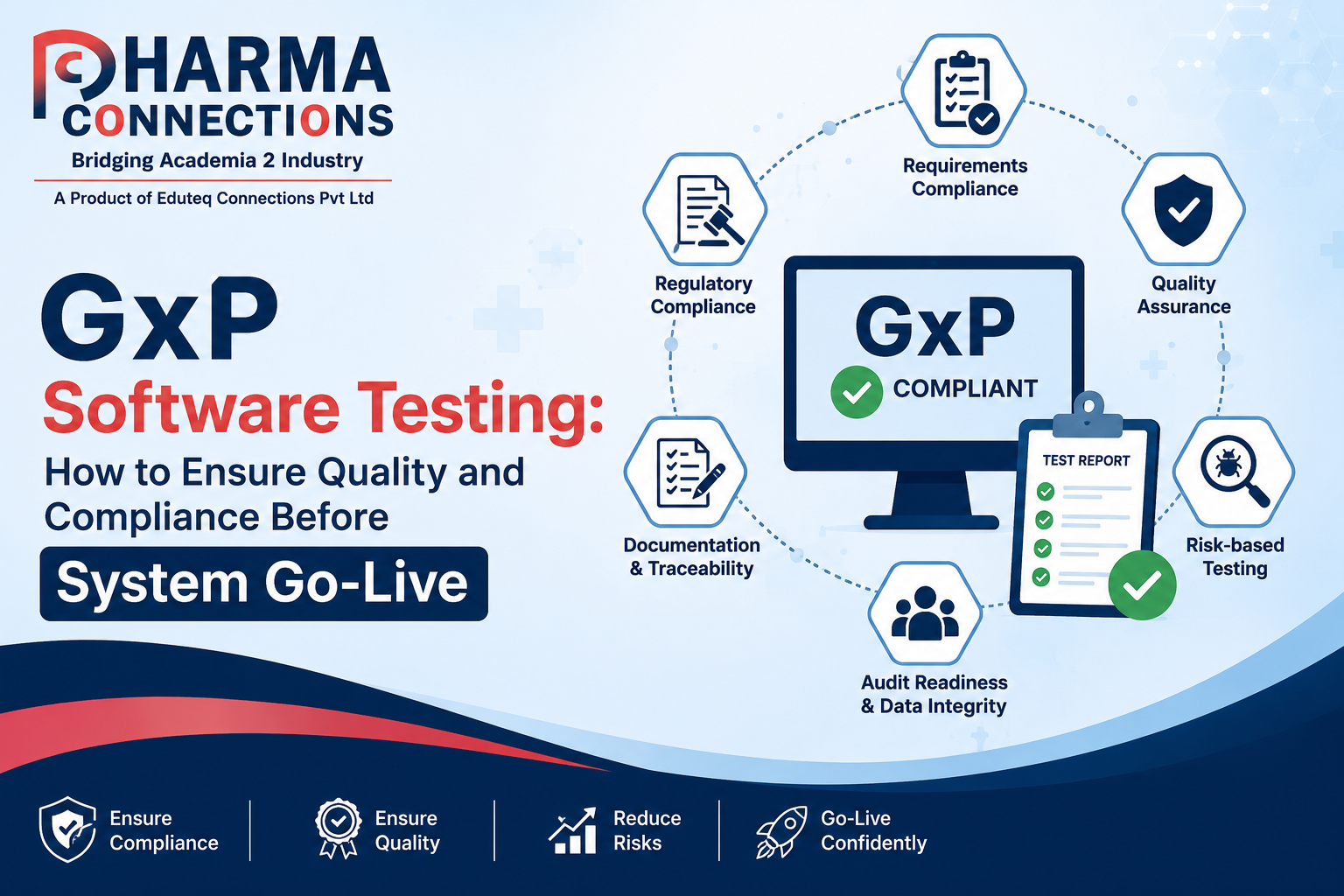
Pharmaceutical companies use computerized applications in manufacturing, laboratories, quality management, clinical operations, supply chain, and…
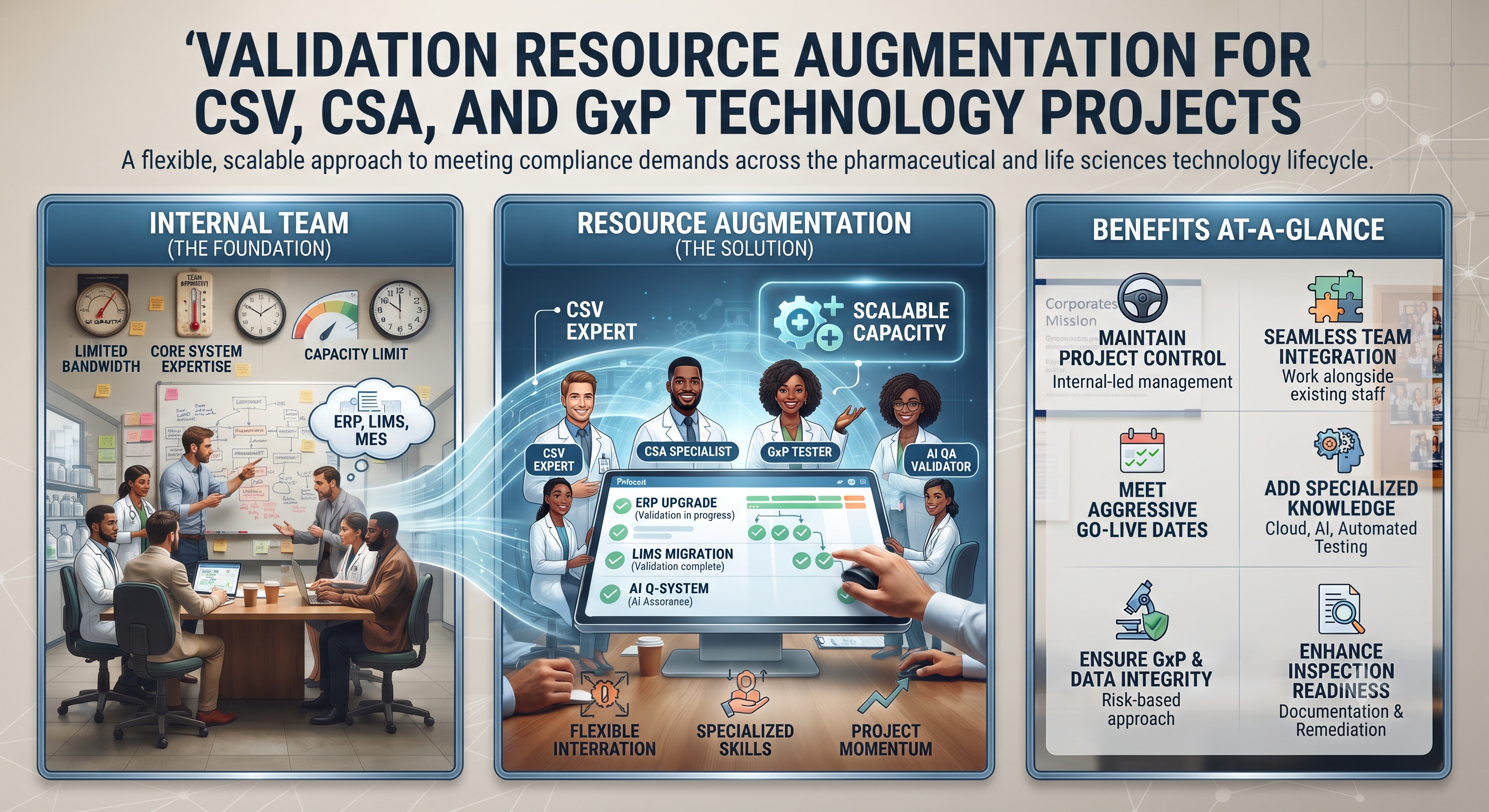
Pharmaceutical validation workloads change rapidly. An internal team with normal operations can find themselves in…
QMS for Pharma Managers has become a key specialization, with pharmaceutical firms placing greater emphasis…

Pharma Connections, Established on February 14, 2019, A Product of Eduteq Connections Pvt Ltd (An ISO 9001:2015 certified company), is dedicated to providing training and upskilling opportunities for Life science Professionals.
Read More